A blog about the peoples and places of the fictional D & D world of Sublanarya during the Tytanyan Age.
Showing posts with label raj-hamut. Show all posts
Thursday, February 22, 2018
Faiths of Sublanarya: The Bringer-of-Rain (Danu, Apep, Shambara, Vritra)
Dyeus the Sky-Father and Tefnas the Earth-Mother were fighting all the time and the world suffered for it. One of the Old Ones, Danu the Liquid Goddess, slipped past the safeguards and even the watchful eye of Ptah-Ra, and combined her essence with that of the Cosmic Serpent, Apep. Though their union was brief, with Dyeus and Tefnas subduing the alien goddess, it brought about the creation of a new threat that the sky and earth, exhausted from destroying Danu and spreading her across the wind and sea, could not subdue. From Apep and Danu was born, Vritra the Consumer.
Vritra was a great wyrm, a dragon with serpentine features, born of disharmony and darkness. As an embodiment and harbinger of Izft, the Envoloper cast darkness upon the River Iru, choking the river, from which all life sprang in ancient Hamutia, with his form.
Along the river, Vritra's asuran servant, Shambara the Builder, built 100 fortresses,like massive temple complexes, in the name of the draconic deity. Around these 100 fortresses, Vritra wrapped a wall of darkness and began choking the life from the world.
Dyeus and Tefnas were weakened but settled their arguments long enough to have more children. Firstborn of the east was the mighty Indra, fierce as a tiger, fast as lightning and with a warcry like thunder. Indra immediately set about trying to tear down the wall of shadow alongside his twin brother, Agni and his four other brothers. But the darkness pushed them back and no amount of force could surpass it. Only the demon ships of Shambara's men were allowed to pass from the sea, through the wall, and along the river.
Mithras had a plan.
Mithras was the youngest and wisest of the brothers. He knew of all creatures big and small that swam in the ocean. For his plan, he knew of a great fish, Apa.
Together, the brothers got Indra drunk on soma, the divine drink of the gods, disguised him as an ox's head, and cast him into the deep part of the sea. The great fish Apa swallowed Indra whole but suffered terrible indigestion. Fighting the beast from the inside, Indra guided it towards a demon pirate ship and killed Apa from the inside. The massive fish floated to the surface. The greedy demons netted Apa, dragged it from the primordial sea, traveled through the wall of darkness and up the river Iru.
Indra had been stuck in the belly of the fish for too long. He was furious and hungry. The golden god ate a whole out of Apa's belly and killed the pirates. He then turned his attentions on the 100 fortresses of Shambara. Each fortress fell to the might of Indra, lightning crashed and thunder roared, as he made his way to the 100th fortress.
There he faced Shambara. The asuran warlord was angry, proud and spiteful. He insulted Indra's smell, from the guts of Apa, and this caused Indra to fly into a drunken rage. The storm king threw Shambara down and tore his head from his shoulders, so he could never hold his nose or snark at the god again, before tossing the head into the heavens. To this day, the head circles the cosmos as a comet that returns periodically called "Shambara's Head".
100 fortresses destroyed and Shambara slain, Vritra descended on Indra to avenge his servants and slay his immortal foe. The two fought a legendary battle with Vritra breaking Indra's jaw but, as the fiend gloated, Indra flew into his mouth and summoned a storm inside of Vritra that destroyed him, casting his body down, and crushing the rest of his servants. Indra then gathered up all the water and threw it into the heavens. From that day on, he was known as the Bringer of Rain and the Storm King.
Together, with his brothers help, Indra buried the Wyrm deep within the earth but his servants still hear his whispers.
Sunday, February 18, 2018
Faiths of Sublanarya: The She-Lion and the Buffalo Demon (Mahisha, Durga)
It was during the Wyrd Wars, that the battle between the She-Tiger and the Buffalo demon came to pass. The lesser Raj-Hamutian gods, the Devi, has been at war with the asura, their fiendish enemies, led by the buffalo demon, Mahisha. Indra the Storm King led the devi bravely and it seemed assured that he would lead them to victory over the asura but Mahisha gained a powerful boon that tipped the war in his favor:
He gained the gift that no man could kill him. The devi were defeated and forced to retreat into the mountains. There they prayed for help and the goddess Shakti hearing the devi, who were like her own children, crying out in despair came to render aid with her mercy. Their prayers coalesced and the Mother-Of-Many transformed into a form that was as terrible and mighty as it was beautiful and serene: Durga the Merciful.
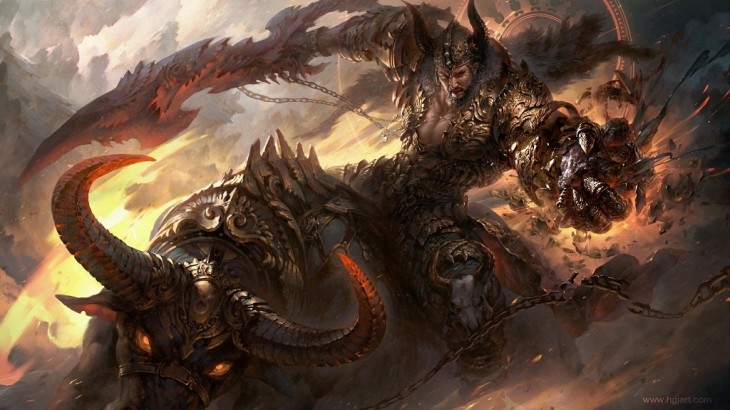
Their leader, Mahisha, laughed heartily as he thought that he could hear the wailing of his foes atop the mountain. He led his army up the mountainside, slowly, soaking in the assured victory that would see him reign over all of Hamutia. But the sound he heard wasn't the wailing of the gods. It was the warcry of just one goddess. Durga came down the mountain astride a golden lion like a sunrise coming over the horizon. The demons fell back at the sight of her majesty but Mahisha stood to meet the goddess in combat. He had not considered the technicality of his invincibility.
No man could kill Mahisha. But Durga was no man. Durga was a goddess.
She knocked him off of his own buffalo and the lion that durga rode upon swallowed the buffalo in one bite. Mahisha's joy turned to fear. He backpedaled and tried to join his fleeing army. The goddess and her lion maimed and devoured his forces as they chased him, turning the soil red with their blood, until finally the lion pounced upon him. The demon was scared, overwhelmed and desperate but the goddess was calm, collected, and serene as she took his life.
The buffalo was slain and Durga, the merciful counterpart of Kali, completed the female Trimurti.
He gained the gift that no man could kill him. The devi were defeated and forced to retreat into the mountains. There they prayed for help and the goddess Shakti hearing the devi, who were like her own children, crying out in despair came to render aid with her mercy. Their prayers coalesced and the Mother-Of-Many transformed into a form that was as terrible and mighty as it was beautiful and serene: Durga the Merciful.
Their leader, Mahisha, laughed heartily as he thought that he could hear the wailing of his foes atop the mountain. He led his army up the mountainside, slowly, soaking in the assured victory that would see him reign over all of Hamutia. But the sound he heard wasn't the wailing of the gods. It was the warcry of just one goddess. Durga came down the mountain astride a golden lion like a sunrise coming over the horizon. The demons fell back at the sight of her majesty but Mahisha stood to meet the goddess in combat. He had not considered the technicality of his invincibility.
No man could kill Mahisha. But Durga was no man. Durga was a goddess.
She knocked him off of his own buffalo and the lion that durga rode upon swallowed the buffalo in one bite. Mahisha's joy turned to fear. He backpedaled and tried to join his fleeing army. The goddess and her lion maimed and devoured his forces as they chased him, turning the soil red with their blood, until finally the lion pounced upon him. The demon was scared, overwhelmed and desperate but the goddess was calm, collected, and serene as she took his life.
The buffalo was slain and Durga, the merciful counterpart of Kali, completed the female Trimurti.
Durga the Merciful
Title(s)
The She-Lion, The Serene, The Warrior Princess, The Wailing of the Gods
Pantheon(s)
Hamutian
Power Level
Greater Deity
Alignment
Lawful Good
Symbol
A warrior goddess astride a lion
Portfolio
Singing, mercy, grace, female warriors, combat
Domains
War
Worshipers
Warriors, righteously vengeful women (especially mothers), catfolk, dancers
Favored Weapon
Trident
Mahisha the Buffalo Demon
Title(s)
The Stubborn Bull, The Invincible General, The Iron Buffalo
Pantheon(s)
Hamutian
Power Level
Lesser Deity
Alignment
Chaotic Evil
Symbol
A water buffalo's horns with an upside down crown
Portfolio
Strength, durability, pride, determination, cruelty
Domains
War
Worshipers
Warlords, minotaurs, beastfolk, demons, cultists
Favored Weapon
Swords
Tuesday, February 13, 2018
Faiths of Sublanarya: Elephants, Snakes and the Moon (Shakti, Heramba, Kali, Manasa, Murugan, Thoth-Khonshu, Aubi)
The goddess Shakti was lonely in the home of her husband, the all-powerful Shiva, who was busy aboard. She was shaping clay into objects for her home and she had an idea: to form a child, a boy, out of the clay. As she did so, she was enamored with the handsome little figure and so, with the boundless love and power of the motherly goddess, a power that was a match for even Shiva, she gave it life and called her son Heramba.
Heramba had a mighty hunger and so, telling Heramba to guard the palace until she returned, Shakti went to the jungle to find food for him.
Shiva returned to surprise his wife and found a handsome youth blocking his entry. He told the boy to let him pass but the boy said that no one could enter without his mother's permission. Not realizing that the boy was his own son, Shiva fought the boy. He was surprised by the boy's courage and strength but none can resist the destructive power of Shiva. He beheaded the boy and went inside his palace.
When Shakti returned, she was mad with grief at the sight of her fallen boy and transformed into her most terrible form, Kali the Annhilator.
Even Shiva fears Kali; she is his equal in power and purpose but guided with a righteous ferocity that is a horror to behold. She set upon Shiva, beating and berating him for his callous act of violence against Heramba, until the mightiest of gods was forced to relent and beg his wife for forgiveness. He called out to his servants and told them to find his son a worthy replacement for his head-- and fast to placate his wife's fury.
The first creature they found was an elephant and, in their haste, this is how Heramba was given his iconic appearance and wisdom. Kali reverted to Shakti and Shiva welcomed his son into heart with open arms. But this was not the only story of Heramba. The other is of how he lost one of his tusks...
Heramba had two siblings: Murugan the Divine Spear, the handsome, swift and proud warrior god, and Manasa the Green Physician, the beautiful serpentine goddess and divine doctor. Manasa was known to play her two brothers against each other in contests since Murugan was cocky and Heramba was stubborn. It often made for an amusing contest between the two brothers but none was more famous than the "Cake Race".
Manasa immediately took off on his peacock and shot off across the sky. Heramba did not leave the palace. Instead, he found his parents and embraced them seven times. He had put into practice the idiom: "He who circles his parents in his embrace, circles the world in his arms". Before Murugan could make it to the horizon, Heramba had already crossed the world and won the bet.
Heramba was married and got to take the first slice of cake. Unfortunately, Heramba's weakness is food. The god could not control himself and, after tasting the first bite of the cake, gobbled the rest of it down. The gods were furious and chased him from his own wedding party. He escaped on the back of his loyal mouse steed Kroncha.
Thoth-Khonshu the Moon Counselor to the gods of Ptah-Hamut laughing and mocking him. Heramba broke off one of his own tusks and, with a force like a hurricane, threw the tusk with such force that it split the moon into three pieces. Raj-Hamutians say this is why there are three moons in the sky.
Thoth-Khonshu's wife Aubi the Scribe is said to use the tusk as a quill so he never forgets diligence and restraint again.
SHAKTI THE MOTHER OF MANY
Title(s)
The Divine Cow, The Triumvirate Goddess, The Forgiver, She of Three Sides, The Supreme Chakra
Pantheon(s)
Hamutian
Power Level
Greater Deity
Alignment
Neutral Good
Symbol
A heart framed in a cows horns
Portfolio
Love, creation, destruction, forgiveness, energy
Domains
Life
Worshipers
Mothers, healers, midwives, women, shepherds
Favored Weapon
Trident
HERAMBA THE GENTLE GIANT
Title(s)
The Remover of Obstacles, Leader of the Group, Humble Headed, One-Tusk, The Elephant God
Pantheon(s)
Hamutian
Power Level
Lesser Deity
Alignment
Neutral Good
Symbol
An elephant's head
Portfolio
Prosperity, Peace, Perseverance, Cunning, Animals
Domains
Nature, Protection
Worshipers
Druids, haathraji, beastfolk, elephant herds, common folk
Favored Weapon
Swords
KALI THE ANNHILATOR
Title(s)
The Destroyer Goddess, The Unforgiving, The Fury, The Dark Mother, The Horned Dragon
Pantheon(s)
Hamutian
Power Level
Greater Deity
Alignment
Chaotic Evil
Symbol
A bleeding skull
Portfolio
Destruction, annihilation, violence, assassination, rage
Domains
Death, War
Worshipers
Assassins, witches, demons, warriors, women
Favored Weapon
Sickle
MANASA THE GREEN PHYSICIAN
Title(s)
The Snake Goddess, The Divine Doctor, The God's Physician, The Python Queen, The Wisewoman
Pantheon(s)
Hamutian
Power Level
Lesser Deity
Alignment
Neutral Good
Symbol
A python curled around a lotus scepter
Portfolio
Snakes, poison, medicine, healing, forests
Domains
Life, Nature
Worshipers
Healers, doctors, wisewomen, druids, yuan-ti
Favored Weapon
Dagger
MURUGAN THE DIVINE SPEAR
Title(s)
The Peacock, The Warrior of Heaven, The Proud and Handsome Son, True-Of-Aim, The Battle Dancer
Pantheon(s)
Hamutian
Power Level
Lesser Deity
Alignment
Neutral
Symbol
A peacock clutching a spear
Portfolio
War, battle, courage, victory, fury
Domains
War
Worshipers
Warriors, bachelors, athletes, princes, lovers
Favored Weapon
Spears, Bows
THOTH-KHONSHU THE MOON COUNSELOR
Title(s)
The Ibis, The Loremaster, The Lunar Prince, The Wisest Son of Yasar, The
Pantheon(s)
Hamutian
Power Level
Greater Deity
Alignment
Lawful Neutral
Symbol
An ibis and a quill
Portfolio
The moon, history, wisdom, justice, education
Domains
Knowledge
Worshipers
Judges, advisors, teachers, loremasters, scholars
Favored Weapon
Darts
AUBI THE SCRIBE
Title(s)
The Writer, The Author, The Spotted Goddess, The Knower-Of-Knowledge, The Ink-Spotted
Pantheon(s)
Hamutian
Power Level
Lesser Deity
Alignment
Neutral
Symbol
Cheetah with a palm leaf
Portfolio
Writing, scribes, astronomy, learning, poetry
Domains
Knowledge
Worshipers
Scribes, catfolk, assistants, writers, bards
Favored Weapon
SwordsTuesday, October 3, 2017
Faith of Sublanarya: The Many Faces of Sahasranama (Bonus: Dyeus, Tefnas, Shanka, Kartavirya, Narakasura)
Sahasranama is the almighty god of the Hamutian pantheon. He is part of a trimurti but Brahma, who acts as the creative force, and Shiva, who acts as the destructive force, arguably serve Sahasranama's vision for the universe. There are other interpretations of this relationship and some cults emphasize one of the trimurti over the others, but Sahasranama is the focus of most of Raj-Hamutian mythology.
These stories usually come in the form of his avatars acting to change the world and educate the masses. The most famous of his avatars is the Rama, who has been discussed in the Ramayana, but there were six avatars before him and have been two since. There is said to be a 10th avatar on the horizon but only time will tell. Now, let's look at the various avatars of Sahasranama.
Labels:
avatar,
avatars,
Dyeus,
hamutian,
Kartavirya,
krishna,
kurma,
mastya,
Narakasura,
narsimha,
parashurama,
raj-hamut,
ramayana,
religion,
sahasranama,
Shanka,
siddhartha,
Tefnas,
vamana,
varaha
Thursday, September 28, 2017
Faiths of Sublanarya: The Ramayana (Sahasranama, Brahma, Shiva, Padma, Sharada, Ravana, Vayu, Hanuman, Jatuya, Mithras, Agni, Indra)
The story of the Ramayana is a central story in Raj-Hamutian religious beliefs but also plays a big part in the cultural oeuvre of the modern Raj-Hamutian. It tells the story of Rama, a prince born in the kingdom of Yodhya and the seventh avatar of the creator god Sahasranama, and his hero's journey. It is an epic that champions of the four sutras: accordance, pursuance, love and liberation. His story is split into tomes of his life.
This article also details of most raj-hamutian dieties.
Thursday, August 31, 2017
Monster Mash: H is for Haathraji
Ancient scripture dictates that the beastfolk of Narya are the chosen people of their gods and Heramba's people, the haathraji or "elephant kings", care for the most innocent denizens of the jungle with generous patience and, when needed, protect them with unstoppable force.
These gentle giants each stand well over twenty feet tall and weigh in at almost four metric tons and have the appearance and gravitas of their elephant ancestors.Their trunks notably split into two, allowing for even better manipulation of this secondary limb, and their tusks are proportionally smaller. They wear ornate outfits of a monk with white, red and gold linens strung up with beads and baubles ranging from materials as common as wood to their ancestor's ivory to jade and gold. These items hold mostly sentimental value, representing relationships and milestones in their life's path, and they have a fondness for gifts of all costs from their friends and allies.
Forest Sages. Haathraji spend most of their time in nomadic familial troupes, often shepherding elephants as a discipline, and their daily routines are focused on meditation, exercise, music, martial arts, and, of course, finding food to sustain themselves. The elephantfolk usually avoid human civilization which, from experience, is driven by material desires, have little respect for nature, and pervert the spiritual truth. Still, they get along well with the humble and poor, especially those living rurally near or in the jungle. The haathraji have no quarrel when it comes to helping others out of trouble but avoid creating a dependence between themselves and humans.
If a human truly wishes to seek wisdom and enlightenment, haathraji are more likely to welcome them into their troupe and share their deep insights.
Warrior Priest of Heramba. While being peace-loving creatures, primarily concerned with enlightenment, when roused the Haathraji are legendary warrior monks that can stand toe to toe with almost any threat to or from the jungle. Despite their size, the haathraji can move as quietly and quickly as a dancer, and on the battlefield toss their enemies, if they don't flatten them, like blades of grass being blown about by the wind.
They especially despise fiendish and unnatural creatures and can be roused to a cause against them.
Saturday, May 6, 2017
Hamutian Pantheon: The Suryayana (Surya, Tvastar, Saranya, Chaya, Yama, Rakta-Beej, Yami)
Surya is the sun god of the Raj-Hamutian Pantheon. He is often compared to Aurelion the Golden Sun for his beauty and goodness. It is possible the two gods are one in the same even if that interferes with their respective origins.
Surya's most famous legend involves his marriage to the daughter of Tvastar the Golden Spider.
Friday, April 28, 2017
The Twin Empires of Hamutia: Ptah-Hamut and Raj-Hamut
Today's subject is of two lands. Separated by a sea, each empire claims dominion of the world: in the east, where the sun rises, is the lush tropical mountainous river-princedoms of Raj-Hamut [rahj-ha-moot], also known as the Emerald Empire for its natural riches and, across the sea to the west, is the cradle of human civilization, built along rivers in a harsh desert, the Empire of the Divine Sun, Ptah-Hamut [puh-tah-ha-moot]. These two states have opposed each other for over two millennia, even pitting their gods against each other, in a struggle for power not only in the material but the spiritual spheres. These two empires, the twin empires of Hamutia, or simple the Hamuts, were once one in the same.
Three and a half millennia ago, on a habitable green spot of land along the River Yor, a small settlement grew and flourished in the inundated plains until it became established as the first Sublanaryan human city of Aneb. The peoples of Yor River built their burgeoning empire upon the ruins of civilizations lost to time or record in a place they call the Valley of Dead Kings. Building upon this history, in the land they called Ptah-Hamut which translates to "the divine lands, they created their own empire with their own god-king, the first "pharaoh", Namor-Ra.
Namor-Ra's descendants would be treated as living gods, directly receiving their authority from Ptah-Horus the Sun-Wielder himself, and protected by their will. To venerate their gods, those of heaven, Hamut and the underworld, they built great monuments to the gods and impressive tombs to house the remains of the pharaoh and his subjects.
To build these wonders, the Ptah-Hamuts used their wealth of resources to feed great armies and enslaved the "lesser peoples" of the continent. Eventually, their conquest spread across the sea to the east, they conquered the fallen kingdoms of Sindahar and established the second part of their empire-- Raj-Hamut "land of princes". This was a means to an end:
In the third and a half millennium of the second epoch, the god-king Herezbek had twins: a girl T'Chalthra and a boy Magarda. The former was born first and therefore it seemed her birthright was to be his successor. These twins were not the first royal twins; the god-king's line had seen many twins born to Hamut before and, inevitably, there was conflict. Assassinations, attempted coup de tats, and even small civil wars had been fought over the throne. Herezbek's solution was to create a new kingdom for his son to rule. This prevented civil war and, to further protect the throne of Ptah-Hamut, the eastern continent became a land split between princes, also called rajahs or sultans, with a maharaja or grand sultan at the top. By dividing the roles of leadership, this created more positions and less intense rivalry for the position of god-king among the royal line.
From that point onward, the first born of the god-king was the heir to the throne of Ptah-Hamut. If the god-king had twins, the second born would become the heir of the reining maharaja. The majaraja's firstborn would be his heir, if not supplanted by the pharoah's twin child, and/or his other sons would be rajas of small princedoms of Raj-Hamut. The rajas battle for control of their small kingdoms but all under the command of the maharaja in the capitol of Kuthkuta.
This created a unique balance of power between members of the royal family that would last for several centuries until the god-king Nexret had twin daughters Wadjet and Nekhbet. This was a problem for a variety of reasons.
In six centuries, the religious practices and beliefs of Raj-Hamut created a culture that was much different than the home culture. The native religious beliefs and stories were reincorporated with Ptah-Hamutian beliefs. The rivalry between princes and disdain for the "rule of the foreign god-king" created a rift that was reflected in their religious beliefs and cultural customs. And, in all that time, Raj-Hamut had never had a female ruler and the maharaja Bara, with the backing of the armies of the princedoms of Raj-Hamut rebelled against the ma'at or "divine order" of Ptah-Hamut's reign. The resulting civil war lasted for decades and had many epic battles. By the end, Bara, Wadjet and Nekhbet were all slain, as well as many other princes and royalty. The result was that the two empires permanently split, bitterly, and remain rivals to this day over dominion of the divine kingdom of Hamut.
From this war sprouted the divine Cult of the Two Ladies. This cult says that Wadjet and Nekhbet ascended to godhood as consorts of Ptah-Horus and that they watch over the royal family of the god-kings. They are represented in the headdresses and iconography of the pharaoh as a vulture and cobra. They are also considered to represent the promise of a reunion of the two kingdoms.
The war also sprouted the first slave rebellion. The slaves that fled during the civil war formed the first wave of colonists of modern Zafaria along the Nadjabadi coast.
It was during the following between the following period, between the 57th and 60th centuries, that the cult evolved so that a serpent, the supposed descendant of the cosmic serpent and Wadjet, calling itself Apep II became the new pharaoh of Ptah-Hamut. Snake cults are a constant in Hamutian history and this one managed to sit itself upon the throne. Apep II was a serpent of gargantuan size, power and intellect. Only through a rebellion led by slaves, who would later become modern Zafarians who settled in Jalatia, was the snake cult overthrown and the pharoah's line properly restored.
But the god-king's empire has been in decline ever since that indignity.
It was during the post-split that came the era known as "classic Raj-Hamut". During this time period, there were many legendary wars fought between demons, gods, and heroes in the style of the Wyrd Wars Sindahar civilization. For example, Krishna the Beautiful who was a sage prince who overthrew a cruel raja and tutored other princes on appropriate behavior. Such education, via a spiritual awakening from rediscovered history of ancient Hamut, reformed the spiritual lives of Raj Hamut with teachers like the latest avatar of Sahasranama, Prince Siddhartha the Awakened Soul.
This cultural revolution has allowed Raj-Hamut to flourish as an empire of individuals. But have they too began to fall behind the rest of Sublanarya?
Three and a half millennia ago, on a habitable green spot of land along the River Yor, a small settlement grew and flourished in the inundated plains until it became established as the first Sublanaryan human city of Aneb. The peoples of Yor River built their burgeoning empire upon the ruins of civilizations lost to time or record in a place they call the Valley of Dead Kings. Building upon this history, in the land they called Ptah-Hamut which translates to "the divine lands, they created their own empire with their own god-king, the first "pharaoh", Namor-Ra.
Namor-Ra's descendants would be treated as living gods, directly receiving their authority from Ptah-Horus the Sun-Wielder himself, and protected by their will. To venerate their gods, those of heaven, Hamut and the underworld, they built great monuments to the gods and impressive tombs to house the remains of the pharaoh and his subjects.
To build these wonders, the Ptah-Hamuts used their wealth of resources to feed great armies and enslaved the "lesser peoples" of the continent. Eventually, their conquest spread across the sea to the east, they conquered the fallen kingdoms of Sindahar and established the second part of their empire-- Raj-Hamut "land of princes". This was a means to an end:
In the third and a half millennium of the second epoch, the god-king Herezbek had twins: a girl T'Chalthra and a boy Magarda. The former was born first and therefore it seemed her birthright was to be his successor. These twins were not the first royal twins; the god-king's line had seen many twins born to Hamut before and, inevitably, there was conflict. Assassinations, attempted coup de tats, and even small civil wars had been fought over the throne. Herezbek's solution was to create a new kingdom for his son to rule. This prevented civil war and, to further protect the throne of Ptah-Hamut, the eastern continent became a land split between princes, also called rajahs or sultans, with a maharaja or grand sultan at the top. By dividing the roles of leadership, this created more positions and less intense rivalry for the position of god-king among the royal line.
From that point onward, the first born of the god-king was the heir to the throne of Ptah-Hamut. If the god-king had twins, the second born would become the heir of the reining maharaja. The majaraja's firstborn would be his heir, if not supplanted by the pharoah's twin child, and/or his other sons would be rajas of small princedoms of Raj-Hamut. The rajas battle for control of their small kingdoms but all under the command of the maharaja in the capitol of Kuthkuta.
This created a unique balance of power between members of the royal family that would last for several centuries until the god-king Nexret had twin daughters Wadjet and Nekhbet. This was a problem for a variety of reasons.
In six centuries, the religious practices and beliefs of Raj-Hamut created a culture that was much different than the home culture. The native religious beliefs and stories were reincorporated with Ptah-Hamutian beliefs. The rivalry between princes and disdain for the "rule of the foreign god-king" created a rift that was reflected in their religious beliefs and cultural customs. And, in all that time, Raj-Hamut had never had a female ruler and the maharaja Bara, with the backing of the armies of the princedoms of Raj-Hamut rebelled against the ma'at or "divine order" of Ptah-Hamut's reign. The resulting civil war lasted for decades and had many epic battles. By the end, Bara, Wadjet and Nekhbet were all slain, as well as many other princes and royalty. The result was that the two empires permanently split, bitterly, and remain rivals to this day over dominion of the divine kingdom of Hamut.
From this war sprouted the divine Cult of the Two Ladies. This cult says that Wadjet and Nekhbet ascended to godhood as consorts of Ptah-Horus and that they watch over the royal family of the god-kings. They are represented in the headdresses and iconography of the pharaoh as a vulture and cobra. They are also considered to represent the promise of a reunion of the two kingdoms.
The war also sprouted the first slave rebellion. The slaves that fled during the civil war formed the first wave of colonists of modern Zafaria along the Nadjabadi coast.
It was during the following between the following period, between the 57th and 60th centuries, that the cult evolved so that a serpent, the supposed descendant of the cosmic serpent and Wadjet, calling itself Apep II became the new pharaoh of Ptah-Hamut. Snake cults are a constant in Hamutian history and this one managed to sit itself upon the throne. Apep II was a serpent of gargantuan size, power and intellect. Only through a rebellion led by slaves, who would later become modern Zafarians who settled in Jalatia, was the snake cult overthrown and the pharoah's line properly restored.But the god-king's empire has been in decline ever since that indignity.
It was during the post-split that came the era known as "classic Raj-Hamut". During this time period, there were many legendary wars fought between demons, gods, and heroes in the style of the Wyrd Wars Sindahar civilization. For example, Krishna the Beautiful who was a sage prince who overthrew a cruel raja and tutored other princes on appropriate behavior. Such education, via a spiritual awakening from rediscovered history of ancient Hamut, reformed the spiritual lives of Raj Hamut with teachers like the latest avatar of Sahasranama, Prince Siddhartha the Awakened Soul.
This cultural revolution has allowed Raj-Hamut to flourish as an empire of individuals. But have they too began to fall behind the rest of Sublanarya?
Thursday, April 27, 2017
Character Crunch: Vanara (Monkey-Folk)
In southern Raj-Hamut, deep in the Dandaka Forest and between the Ondon Mountains, hidden in mist and legend, is Kishkindha, the kingdom of the vanara: the "forest people". The vanara of Kishkindha resemble monkey-like humanoids. They are mostly known to be clever, curious and playful creatures that might irritate less patient creatures with their constant questioning and almost naive honesty. While vanara often admire the accomplishments of human society, they find human's comparably uptight customs and rules amusing. They prefer to play tricks upon people rather than resorting to violence to expel them from the sacred sites, such as temples and burial grounds, they often make their homes. That doesn't mean they won't defend themselves.
The vanaran patron deity Hamuman the Mighty is famous for the feat of lifting an entire mountain with one hand and leading armies of vanara to assist the 7th Avatar of Sahasranama. They are known for being impressive warriors who use their unmatched agility and bestial ferocity to overcome their foes. And their foes are, usually, evil, which vanara oppose universally. Vanaran heroes prefer martial arts whether they be masters of force like barbarians or fighters or instead prefer the subtlety of rangers or thieves or choose to find a balance with a monk.
The heroism, loyalty and bravery of vanara warriors is legendary.
Vanara are rarely found outside of Kishkindha but they are not unheard of among veteran adventurers who have ventures to the south-eastern continent of Raj-Hamut. They are usually drawn into a life adventure by curiosity and loyalty; many a human adventurer has found themselves Kishkindha on a divine quest and befriended a vanara. Perhaps the human save the vanara's life or better yet their tribe and so, out of devotion, obligation and/but mostly out of the desire to join them on their quest, they join the hero on their adventure and become adventurers in their own right.
Vanara come in two distinct varieties on a spectrum of more monkey-like to more human-like in appearance. They both often intermingle and are more alike than either are with monkeys or humans. There are mountain and valley vanara.
Preferring to live in hills and crags of the Ondon Mountains, the mountain vanara could almost pass for humans or elves at a glance.
They usually are built similarly to elves-- tall with slender builds-- with similar facial structures and even have point ears. Unlike elves, their pointed ears tend to be much more pronounced and bestial. The biggest give away to their vanaran nature are their prehensile simian tails, long fingers and toes, and pronounced canines. They often have lighter hair from blond to brown to red hair that matches the fur on their tail and some even have thick fur-like hair on their bodies as well.They have the same range of eye colors as humans that flash to red when angry or in battle.
Mountain vanara are known to be a little more reserved than their valley kin and tend to build small villages, usually around a sacred tree or spring or in or around an ancient temple, where they can live simply and carefree lives. They tend to be the most pious and most vanaran priests for both the mountain and the valley vanara. This doesn't mean they are not known for their trickery and playfulness but they do tend to be more responsible when it comes to duties.
Valley vanara are noticeably more ape-like than their mountain cousins.
Valley vanara, covered in a coat of white, grey, black, brown or orange fur, with elongated muzzles, large lip-less mouths, big, round ears and facial fur, more closely resemble the "monkey-folk" that are described in popular legends. Some have non-prehensile tails and other have either extremely short or no tails. They tend to have slightly longer limbs than their mountain cousins and their eyes are usually only black or brown in hue that also flash red when enraged.
Valley vanara are hunter-gatherers who live in small family groups usually sharing territory around a central point of interest. They have a more laissez-faire lifestyle, doing as they please, and relaxing away most of their days. Due to their more wild environment, they do have to contend with predators and evil creatures more frequently than mountain vanara. For this reason they have more of a reputation as warriors and hunters than their cousins.
Ability Score Increase. Your Dexterity increases by 2.
Age. Vanara have lifespans equivalent to humans.
Alignment. Vanara
Size. Vanara are similar in size and stature to humans, standing between 5 and 6 feet, with slender builds. Your size if medium.
Speed. Your base walking speed is 30 feet.
Tree Climber. Because of your monkey-like hands and feet, you are almost as well acclimated to climbing as walking. You have climbing speed of 3/4 your walking speed rounded down (minimum 20 feet).
Primal Pounce: You may use Dexterity when determining your jump distance.
Mountain Vanara
Ability Increase. Your Wisdom increases by 1.
Skill Proficiency. You have proficiency in the Acrobatics skill.
Prehensile Tail: Can pick up and carry small objects but not use as weapons. Can use Sleight of Hand with tail.
Valley Vanara
Ability Increase. Your Strength increases by 1.
Skill Proficiency. You have proficiency in the Athletics skill.
I wanna note, Vanara are found elsewhere and there is more than one "monkey king". I hope you guys enjoy my take on this classic race from hindu mythology and Oriental Adventures.
The vanaran patron deity Hamuman the Mighty is famous for the feat of lifting an entire mountain with one hand and leading armies of vanara to assist the 7th Avatar of Sahasranama. They are known for being impressive warriors who use their unmatched agility and bestial ferocity to overcome their foes. And their foes are, usually, evil, which vanara oppose universally. Vanaran heroes prefer martial arts whether they be masters of force like barbarians or fighters or instead prefer the subtlety of rangers or thieves or choose to find a balance with a monk.
The heroism, loyalty and bravery of vanara warriors is legendary.
Vanara are rarely found outside of Kishkindha but they are not unheard of among veteran adventurers who have ventures to the south-eastern continent of Raj-Hamut. They are usually drawn into a life adventure by curiosity and loyalty; many a human adventurer has found themselves Kishkindha on a divine quest and befriended a vanara. Perhaps the human save the vanara's life or better yet their tribe and so, out of devotion, obligation and/but mostly out of the desire to join them on their quest, they join the hero on their adventure and become adventurers in their own right.
Vanara come in two distinct varieties on a spectrum of more monkey-like to more human-like in appearance. They both often intermingle and are more alike than either are with monkeys or humans. There are mountain and valley vanara.
Preferring to live in hills and crags of the Ondon Mountains, the mountain vanara could almost pass for humans or elves at a glance.
They usually are built similarly to elves-- tall with slender builds-- with similar facial structures and even have point ears. Unlike elves, their pointed ears tend to be much more pronounced and bestial. The biggest give away to their vanaran nature are their prehensile simian tails, long fingers and toes, and pronounced canines. They often have lighter hair from blond to brown to red hair that matches the fur on their tail and some even have thick fur-like hair on their bodies as well.They have the same range of eye colors as humans that flash to red when angry or in battle.
Mountain vanara are known to be a little more reserved than their valley kin and tend to build small villages, usually around a sacred tree or spring or in or around an ancient temple, where they can live simply and carefree lives. They tend to be the most pious and most vanaran priests for both the mountain and the valley vanara. This doesn't mean they are not known for their trickery and playfulness but they do tend to be more responsible when it comes to duties.
Valley vanara are noticeably more ape-like than their mountain cousins.
Valley vanara, covered in a coat of white, grey, black, brown or orange fur, with elongated muzzles, large lip-less mouths, big, round ears and facial fur, more closely resemble the "monkey-folk" that are described in popular legends. Some have non-prehensile tails and other have either extremely short or no tails. They tend to have slightly longer limbs than their mountain cousins and their eyes are usually only black or brown in hue that also flash red when enraged.
Valley vanara are hunter-gatherers who live in small family groups usually sharing territory around a central point of interest. They have a more laissez-faire lifestyle, doing as they please, and relaxing away most of their days. Due to their more wild environment, they do have to contend with predators and evil creatures more frequently than mountain vanara. For this reason they have more of a reputation as warriors and hunters than their cousins.
Ability Score Increase. Your Dexterity increases by 2.
Age. Vanara have lifespans equivalent to humans.
Alignment. Vanara
Size. Vanara are similar in size and stature to humans, standing between 5 and 6 feet, with slender builds. Your size if medium.
Speed. Your base walking speed is 30 feet.
Tree Climber. Because of your monkey-like hands and feet, you are almost as well acclimated to climbing as walking. You have climbing speed of 3/4 your walking speed rounded down (minimum 20 feet).
Primal Pounce: You may use Dexterity when determining your jump distance.
Extra Language. You can read, write, speak and understand common, Vanaran, and one extra language.
Subraces. There are two subraces of vanara; the mountain vanara and the valley vanara.Mountain Vanara
Ability Increase. Your Wisdom increases by 1.
Skill Proficiency. You have proficiency in the Acrobatics skill.
Prehensile Tail: Can pick up and carry small objects but not use as weapons. Can use Sleight of Hand with tail.
Valley Vanara
Ability Increase. Your Strength increases by 1.
Skill Proficiency. You have proficiency in the Athletics skill.
Bite.
Your jaw is a strong natural weapon, which can be used to make unarmed
strikes. If you hit with it, you deal piercing damage equal to 1d6 +
your Strength modifier.
I wanna note, Vanara are found elsewhere and there is more than one "monkey king". I hope you guys enjoy my take on this classic race from hindu mythology and Oriental Adventures.
Saturday, April 22, 2017
A House Divided: The Hamutian Religion
Hamut means "kingdom" in Hamutian, the Hamuts are the two kingdoms, Hamutia refers to both kingdoms and all territories they control, and the people and all things from Hamutia, collectively, are described as Hamutians. Hamutia is split into two kingdoms: Ptah-Hamut to the west of the Hamutian Sea and Raj-Hamut to the east of the Hamutian Sea. Peoples from Ptah-Hamut are called Ptah-Hamuts and peoples from Raj-Hamut are called Raj-Hamuts. They speak Hamutian and their gods are collectively part of the Hamutian pantheon.
The Hamutian religion is one that focus on creation, preservation, and destruction of everything from the universe to the individual.
Labels:
faiths,
gods,
hamut,
hamutia,
narya,
ptah-hamut,
raj-hamut,
religion,
sublanarya
Subscribe to:
Comments (Atom)