Showing posts with label zafaria. Show all posts

Friday, May 5, 2017

Evolving Timeline of Narya Part II: Modern History of Sublanarya

For Part I: Ancient History of Sublanarya, click HERE.

The 2nd Epoch: Modern Narya (0 CE to 6667 CE (Present))

The first epoch, what Sublnaryan's call the "Ancient Epoch", is a time of great uncertainty, where reality and myth are intertwined, and the gods are locked in a series of brutal battles over the dominion of time and space. The space itself was constantly shifting in reaction to these battles, as gods can raise mountains and raze forests with ease, and time itself was warped by the destructive cosmic power of war on a scale beyond the understanding of mortals. It was a time that chaos reigned supreme and order struggled to gain a foothold. The current epoch is different.

In the current epoch, order has more than gained a foothold. It has put a boot on the jugular of chaos and the "Current Epoch" (CE) is one of some certainty. If the first epoch was defined by the struggle between order and chaos, between the authorities of the universe, the gods, and those who wish to destroy it, then the current epoch is one shaped by the struggle of good and evil. While both of these metaphorical and material struggles are of concern to the gods, the struggle between good and evil, right and wrong, are of much more consequence to mere mortals. After all, mere mortals are rewarded or punished based on their actions. Gods are all but absolute.

It is important to keep in mind when looking at the last seven millennia of Naryan history, told from a Sublanaryan perspective, that while the gods still guide the peoples of the material plane, the people are now, ultimately, the ones who shape the current state of the world. For better or worse, this is a time of civilizations, of kings and queens, of masters and slaves, and of armies and hordes. This is a period defined by the actions of mortals upon mortals.

The Current Epoch is tangible. Time and space can still be contorted but are less pliable. Years are 400 days long (10 moonths of 40 days) and each day is 25 hours long

Epoch II: Modern Narya
 (Summary)
1st Age: The Age of Wonders and Wandering
2rd Age: The First Dark Age: Rise of the Giants
3rd Age: The Age of Restoration
4th Age: The Second Dark Age: The Beastmen Invasion and The Holy Crusades
5th Age: The Tytanyan Age

Here goes:

Friday, April 28, 2017

The Twin Empires of Hamutia: Ptah-Hamut and Raj-Hamut

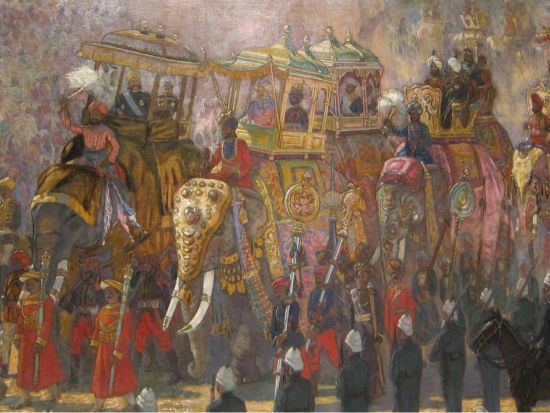
Today's subject is of two lands. Separated by a sea, each empire claims dominion of the world: in the east, where the sun rises, is the lush tropical mountainous river-princedoms of Raj-Hamut [rahj-ha-moot], also known as the Emerald Empire for its natural riches and, across the sea to the west, is the cradle of human civilization, built along rivers in a harsh desert, the Empire of the Divine Sun, Ptah-Hamut [puh-tah-ha-moot]. These two states have opposed each other for over two millennia, even pitting their gods against each other, in a struggle for power not only in the material but the spiritual spheres. These two empires, the twin empires of Hamutia, or simple the Hamuts, were once one in the same.

Three and a half millennia ago, on a habitable green spot of land along the River Yor, a small settlement grew and flourished in the inundated plains until it became established as the first Sublanaryan human city of Aneb. The peoples of Yor River built their burgeoning empire upon the ruins of civilizations lost to time or record in a place they call the Valley of Dead Kings. Building upon this history, in the land they called Ptah-Hamut which translates to "the divine lands,  they created their own empire with their own god-king, the first "pharaoh", Namor-Ra.

Namor-Ra's descendants would be treated as living gods, directly receiving their authority from Ptah-Horus the Sun-Wielder himself, and protected by their will. To venerate their gods, those of heaven, Hamut and the underworld, they built great monuments to the gods and impressive tombs to house the remains of the pharaoh and his subjects.

To build these wonders, the Ptah-Hamuts used their wealth of resources to feed great armies and enslaved the "lesser peoples" of the continent. Eventually, their conquest spread across the sea to the east, they conquered the fallen kingdoms of Sindahar and established the second part of their empire-- Raj-Hamut "land of princes". This was a means to an end:

In the third and a half millennium of the second epoch, the god-king Herezbek had twins: a girl T'Chalthra and a boy Magarda. The former was born first and therefore it seemed her birthright was to be his successor. These twins were not the first royal twins; the god-king's line had seen many twins born to Hamut before and, inevitably, there was conflict. Assassinations, attempted coup de tats, and even small civil wars had been fought over the throne. Herezbek's solution was to create a new kingdom for his son to rule. This prevented civil war and, to further protect the throne of Ptah-Hamut, the eastern continent became a land split between princes, also called rajahs or sultans, with a maharaja or grand sultan at the top. By dividing the roles of leadership, this created more positions and less intense rivalry for the position of god-king among the royal line.

From that point onward, the first born of the god-king was the heir to the throne of Ptah-Hamut. If the god-king had twins, the second born would become the heir of the reining maharaja. The majaraja's firstborn would be his heir, if not supplanted by the pharoah's twin child, and/or his other sons would be rajas of small princedoms of Raj-Hamut. The rajas battle for control of their small kingdoms but all under the command of the maharaja in the capitol of Kuthkuta.

This created a unique balance of power between members of the royal family that would last for several centuries until the god-king Nexret had twin daughters Wadjet and Nekhbet. This was a problem for a variety of reasons.

In six centuries, the religious practices and beliefs of Raj-Hamut created a culture that was much different than the home culture. The native religious beliefs and stories were reincorporated with Ptah-Hamutian beliefs. The rivalry between princes and disdain for the "rule of the foreign god-king" created a rift that was reflected in their religious beliefs and cultural customs. And, in all that time, Raj-Hamut had never had a female ruler and the maharaja Bara, with the backing of the armies of the princedoms of Raj-Hamut rebelled against the ma'at or "divine order" of Ptah-Hamut's reign. The resulting civil war lasted for decades and had many epic battles. By the end,  Bara, Wadjet and Nekhbet were all slain, as well as many other princes and royalty. The result was that the two empires permanently split, bitterly, and remain rivals to this day over dominion of the divine kingdom of Hamut.

From this war sprouted the divine Cult of the Two Ladies. This cult says that Wadjet and Nekhbet ascended to godhood as consorts of Ptah-Horus and that they watch over the royal family of the god-kings. They are represented in the headdresses and iconography of the pharaoh as a vulture and cobra. They are also considered to represent the promise of a reunion of the two kingdoms.

The war also sprouted the first slave rebellion. The slaves that fled during the civil war formed the first wave of colonists of modern Zafaria along the Nadjabadi coast.

It was during the following between the following period, between the 57th and 60th centuries, that the cult evolved so that a serpent, the supposed descendant of the cosmic serpent and Wadjet, calling itself Apep II became the new pharaoh of Ptah-Hamut. Snake cults are a constant in Hamutian history and this one managed to sit itself upon the throne. Apep II was a serpent of gargantuan size, power and intellect. Only through a rebellion led by slaves, who would later become modern Zafarians who settled in Jalatia, was the snake cult overthrown and the pharoah's line properly restored.

But the god-king's empire has been in decline ever since that indignity.

It was during the post-split that came the era known as "classic Raj-Hamut". During this time period, there were many legendary wars fought between demons, gods, and heroes in the style of the Wyrd Wars Sindahar civilization. For example, Krishna the Beautiful who was a sage prince who overthrew a cruel raja and tutored other princes on appropriate behavior. Such education, via a spiritual awakening from rediscovered history of ancient Hamut, reformed the spiritual lives of Raj Hamut with teachers like the latest avatar of Sahasranama, Prince Siddhartha the Awakened Soul.

This cultural revolution has allowed Raj-Hamut to flourish as an empire of individuals. But have they too began to fall behind the rest of Sublanarya?

Friday, April 7, 2017

The Free Markets & Free Peoples of Zafaria: Jalatia and Nadjabad

The infernal heat keeps the people asleep all day
and so, as night falls on Ersod,
the city and tourists come out to work and play.

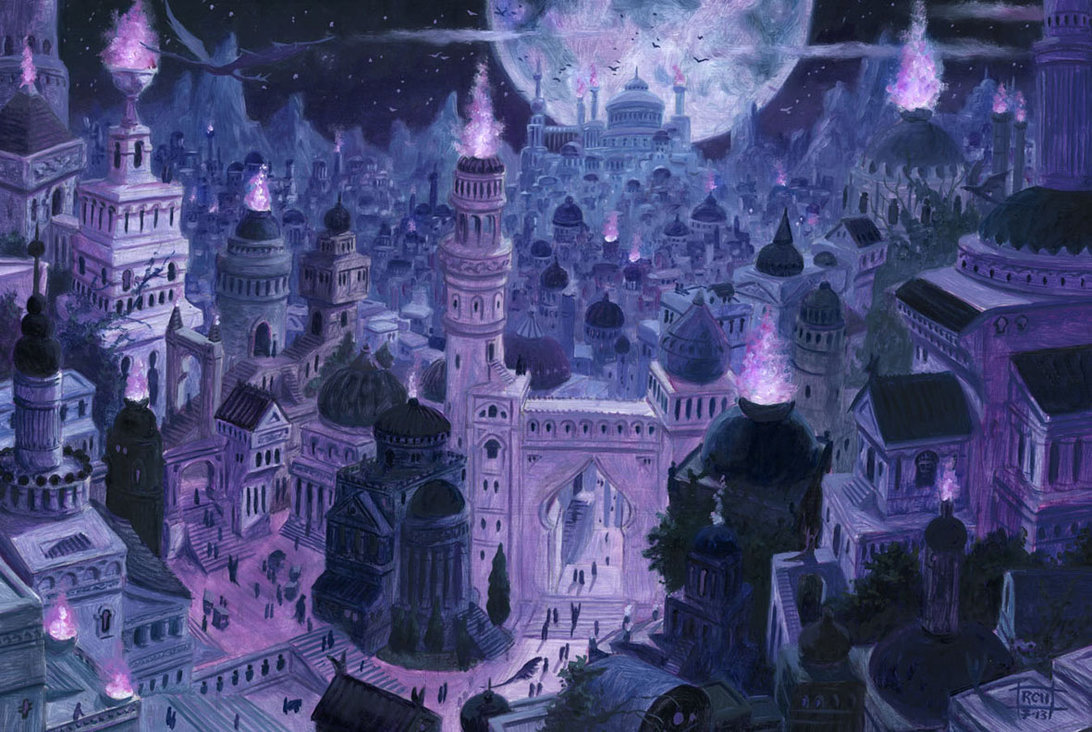
In the City of Endless Nights, as the moon rises over the chilled sands, the glow of the gaslamps and magical braziers turn the cityscape a hue of violet as god-fearing merchants open their food carts to hung-over customers and wayward priests, from across the sea and desert, seek out carnal delights in the brothels-- taking part in act that would curl the beards of any king in Thule. Across the courtyard, a fire-breathing tiefling juggler collects coins from a crowd of children while his partner picks the pockets of their wealthy parents. And, as a gypsy tells the fortune of a young noble couple traveling on their honeymoon, a curious djinn watches and considers how he will benefit from the misfortune he is envisioning for them.

By the time the sun rises in the east, the city will fall all but silent again, until the day's heat wanes.

That is a Zafarian city today. But to understand the present, we must look to the past...

The two large southern continents of Sublanarya are referred to as Hamutia because, for thousands of years, both continents were under the hold of the Hamutian Empire. The Hamutian Empire was a polytheistic monarchal empire in which two kings, two siblings (male or female), ruled on either side of the Hamutian Sea. This empire was built on military conquest, control of valuable resources like drinking water and arable land, and the institution of slavery. It was a powerhouse that survived the Wyrd Wars and continued to dominate the region afterwords. But, as time came to pass, so did the union between Western and Eastern Hamutia.

A civil war broke out between two sibling kings; the western king Ptah-hotep and her brother Jahangari II. Even the Hamutian Pantheon itself split. To the west of the Hamutian Sea, the land became known as Ptah-Hamut, ruled by the all-mighty Pharoah, and to the east lies Raj-Hamut, ruled by the more democratic Rajah and his council of princes. As the war waged on, the slaves of the Hamutian Empire took advantage of the chaos to revolt.

The slaves escaped to the sea and colonized coasts to the north-west of Ptah-Hamut. They had no singular traditions or identity, having been bred from generations of defeated tribe speople and criminals from throughout Hamutia, and so they forged a new cultural identity. They called themselves the Zafarians or "The Unbending." They lived of the inner sea, which came to take their name, and became a prominent nation of merchants. They named their new home on the coast Nadjabad or "the Place of Hope".

And they weathered many small wars against Ptah-Hamut, especially as that lands became entrenched in an even more despicable state.

During the Second Dar Age, a snake cult took control of the pharoah's court and put their god-king, Apep, above all others on Narya. Eventually, the cruelty of the snake cult caused a second slave rebellion. They overthrew the insane cult and reinstalled the pharoah to his throne. As a reward for their nobility, they were offered their freedom. But many of the freed slaves did not wish to continue to be part of a system that continued to perpetuate slavery and instead left for Zafaria. This second wave, bringing their engineering and combat skills, from being forced to build complex architecture and fill out the armies of the snake cult, built walled towns and forts in the mountains of Jalatia on the south-western peninsula of modern day Albyon.

They joined the nation of Zafaria and together the free peoples of Jalatia and Nadjabad have become a small but powerful nation by controlling the Great Western Isthmus and the Zafarian Sea.

Today, the Nadjabadi and Jalatians are one of the most progressive cultures in all of Sublanarya.

Freedom is the promise of Zafaria. A collaboration of former slaves who rebelled against their masters, Zafaria, made up of the mountainous peninsula of Jalatia and the desert coast-line of Nadjabad, is a place where all peoples are free and equal. People are free to live their lives, as they see fit, without the oppression of government or gods, and every man, woman, and child can seize the opportunities that come with this freedom. Few nations welcome outsiders so willingly. Especially the beaten, the tired, the poor, the homeless, and those tossed aside by neighboring nations are welcome to the shores of Zafaria. These people bring their traditions and their values and add them to beautiful hodge-podge of cultures and creeds. Between the white-squared clay buildings, they form a mosaic of broken tiles from a thousand worlds in a thousand colors. And yet...

In Zafaria, coin is king.

While this is a land of opportunity for all, it is not equal opportunity. If anything, those who come to Zafaria are prey for the true sharks that haunt the waters. Pirates, thieves, and crooked merchants rule Zafaria and take advantage of the constant influx of new victims, new targets, and new labor. While freedom is free in Zafaria, life is cheap. Resources are not as abundant as in more verdant regions of Sublanarya and locales are more apt to knowing the ins and outs of taking advantage of opportunities in the markets. Poverty is common, as common as the starvation and disease that are common in the clums of every village and city in Zafaria, and thus the cycle of crime is perpetuated. The only law is made-up of local militia organized by the wealthy merchant families and far too often are they more interested in catching thieves than preventing the kind of cruelty that turns desperate men cruel. That is the price of freedom in Zafaria. Every man for himself. Despite perpetrating slavery being illegal under penalty of death throughout the Zafarian Sea, ships with new slaves find their way to Hamutia every day.

As any Dhole will tell you, "it is a dog eat dog world".