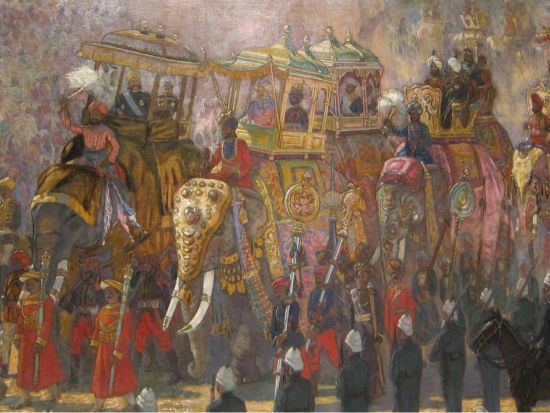
Today's subject is of two lands. Separated by a sea, each empire claims dominion of the world: in the east, where the sun rises, is the lush tropical mountainous river-princedoms of Raj-Hamut [rahj-ha-moot], also known as the Emerald Empire for its natural riches and, across the sea to the west, is the cradle of human civilization, built along rivers in a harsh desert, the Empire of the Divine Sun, Ptah-Hamut [puh-tah-ha-moot]. These two states have opposed each other for over two millennia, even pitting their gods against each other, in a struggle for power not only in the material but the spiritual spheres. These two empires, the twin empires of Hamutia, or simple the Hamuts, were once one in the same.

Three and a half millennia ago, on a habitable green spot of land along the River Yor, a small settlement grew and flourished in the inundated plains until it became established as the first Sublanaryan human city of Aneb. The peoples of Yor River built their burgeoning empire upon the ruins of civilizations lost to time or record in a place they call the Valley of Dead Kings. Building upon this history, in the land they called Ptah-Hamut which translates to "the divine lands, they created their own empire with their own god-king, the first "pharaoh", Namor-Ra.
Namor-Ra's descendants would be treated as living gods, directly receiving their authority from Ptah-Horus the Sun-Wielder himself, and protected by their will. To venerate their gods, those of heaven, Hamut and the underworld, they built great monuments to the gods and impressive tombs to house the remains of the pharaoh and his subjects.
To build these wonders, the Ptah-Hamuts used their wealth of resources to feed great armies and enslaved the "lesser peoples" of the continent. Eventually, their conquest spread across the sea to the east, they conquered the fallen kingdoms of Sindahar and established the second part of their empire-- Raj-Hamut "land of princes". This was a means to an end:

In the third and a half millennium of the second epoch, the god-king Herezbek had twins: a girl T'Chalthra and a boy Magarda. The former was born first and therefore it seemed her birthright was to be his successor. These twins were not the first royal twins; the god-king's line had seen many twins born to Hamut before and, inevitably, there was conflict. Assassinations, attempted coup de tats, and even small civil wars had been fought over the throne. Herezbek's solution was to create a new kingdom for his son to rule. This prevented civil war and, to further protect the throne of Ptah-Hamut, the eastern continent became a land split between princes, also called
rajahs or
sultans, with a maharaja or grand sultan at the top. By dividing the roles of leadership, this created more positions and less intense rivalry for the position of god-king among the royal line.
From that point onward, the first born of the god-king was the heir to the throne of Ptah-Hamut. If the god-king had twins, the second born would become the heir of the reining maharaja. The majaraja's firstborn would be his heir, if not supplanted by the pharoah's twin child, and/or his other sons would be rajas of small princedoms of Raj-Hamut. The rajas battle for control of their small kingdoms but all under the command of the maharaja in the capitol of Kuthkuta.
This created a unique balance of power between members of the royal family that would last for several centuries until the god-king Nexret had twin daughters Wadjet and Nekhbet. This was a problem for a variety of reasons.

In six centuries, the religious practices and beliefs of Raj-Hamut created a culture that was much different than the home culture. The native religious beliefs and stories were reincorporated with Ptah-Hamutian beliefs. The rivalry between princes and disdain for the "rule of the foreign god-king" created a rift that was reflected in their religious beliefs and cultural customs. And, in all that time, Raj-Hamut had never had a female ruler and the maharaja Bara, with the backing of the armies of the princedoms of Raj-Hamut rebelled against the ma'at or "divine order" of Ptah-Hamut's reign. The resulting civil war lasted for decades and had many epic battles. By the end, Bara, Wadjet and Nekhbet were all slain, as well as many other princes and royalty. The result was that the two empires permanently split, bitterly, and remain rivals to this day over dominion of the divine kingdom of Hamut.

From this war sprouted the divine Cult of the Two Ladies. This cult says that Wadjet and Nekhbet ascended to godhood as consorts of Ptah-Horus and that they watch over the royal family of the god-kings. They are represented in the headdresses and iconography of the pharaoh as a vulture and cobra. They are also considered to represent the promise of a reunion of the two kingdoms.
The war also sprouted the first slave rebellion. The slaves that fled during the civil war formed the first wave of colonists of modern Zafaria along the Nadjabadi coast.

It was during the following between the following period, between the 57th and 60th centuries, that the cult evolved so that a serpent, the supposed descendant of the cosmic serpent and Wadjet, calling itself Apep II became the new pharaoh of Ptah-Hamut. Snake cults are a constant in Hamutian history and this one managed to sit itself upon the throne. Apep II was a serpent of gargantuan size, power and intellect. Only through a rebellion led by slaves, who would later become modern Zafarians who settled in Jalatia, was the snake cult overthrown and the pharoah's line properly restored.
But the god-king's empire has been in decline ever since that indignity.
It was during the post-split that came the era known as "classic Raj-Hamut". During this time period, there were many legendary wars fought between demons, gods, and heroes in the style of the Wyrd Wars Sindahar civilization. For example, Krishna the Beautiful who was a sage prince who overthrew a cruel raja and tutored other princes on appropriate behavior. Such education, via a spiritual awakening from rediscovered history of ancient Hamut, reformed the spiritual lives of Raj Hamut with teachers like the latest avatar of Sahasranama, Prince Siddhartha the Awakened Soul.
This cultural revolution has allowed Raj-Hamut to flourish as an empire of individuals. But have they too began to fall behind the rest of Sublanarya?