Showing posts with label goddess. Show all posts

Saturday, April 28, 2018

Faiths of Sublanarya: The Mother Plenty (Aphizia) & Honey-Blessed


Queen Aphizia is one of the nobility of the Court of Dawn but her origins are stranger than fey. She is an alien goddess, like Grimnir, who comes from beyond the stars. She made her home in Narya, long ago, and made herself a kingdom that would make anyone jealous. Her fey kingdom is a gorgeous and endless valley of wildflowers and fruit trees, the air humming with the busy work of fey bees and the singing of her children the kleodora, and in the middle of it all her massive golden castle. Inside, she sits upon her throne, attended and attending to her children.

She has had at least a short relationship with Aurellion that often leads their priests to be at odds.

Aphiza is a goddess whose cults find their way into desolate lands. Her daughters, the kleodora, are beautiful, alien and secretive missionaries who work to spread her influence into these lands by offering gifts of fresh produce and honey. While perhaps put-off by the strange appearance of the kleodora, desperate communities welcome them. It does not take long for the kleodora to offer to give the gift of apiaries, bee hives, and, in exchange for a small temple being built, teaching acolytes how to raise and care for the bees. Within a year, they can turn a famine into a bounty, but in following years, the queen gets her payment.

In order to appease her and the bees, Aphizia demands a yearly human sacrifice. The more elaborate and joyous the festival, despite the gruesome execution of the sacrifice, the better the following season's harvest. Such is the wicked pleasure of a goddess both alien and fey.

Those who fail to appease the queen are punished swiftly either by a plague of flying insects or worse. She is known to make deals, especially from women, for anything from a good harvest or a cured illness. But there is always a price and she is an easily offended goddess.

Particularly pleasing communities are even known to be "pollinated" by the kleodora and these children are called the "honey-blessed". Honey-blessed are often priests and agents of the goddess. Honey-Blessed are notoriously gifted with the beauty and wisdom of their forebearers. The features that stand out are their antennae, which they usually disguise by laying them down in their hair, a thin-layer of fine hair across their body and their eyes which have a composite pattern. While most honey-blessed serve the Mother Plenty, others escape their cult life and attempt a free-life. But the mother does not forget her children.

Ability Score Increase. Your Wisdom increases by 2 and your Charisma increases by 1.
Age. Honey-Blessed have lifespans equivalent to humans.
Alignment. Most honey-blessed are lawful sense the represent the authority of the cult and enforce it with a smile, so they tend towards lawful alignments. Those that break free from the cult might rebel and embrace freedom.
Size. A half-kleodora has the build of a human woman. Your size if medium.
Speed. Your base walking speed is 30 feet.
Fey Ancestry. You have advantage on saving throws against being charmed and magic can't put you to sleep.
Mother's Blessing. You have advantage on saving throws against poison, and you have resistance against poison damage.
Insect Empathy. You have an innate ability to communicate with insects. You have the ability to communicate simple ideas through sounds and gestures with insect-like creatures.
Sting. You know the Infestation cantrip. Your infestation cantrip's spell manifests as a swarm of fey bees. Wisdom is your spellcasting ability for this spell.
Honeyed Words. Your bodily fluids have hypnotic qualities that allow you a limited version of the hivemind-like effect used by kleeodora. When your magic saliva, sweat or tears is consumed, via skin contact or ingestion, the creature must make a Wisdom saving throw. If it fails it is charmed by you until the effect ends, after 1 hour, or until you or your companions do something harmful to it. The charmed creature regards you as a friendly acquaintance. You can only affect a number of creatures with this spell equal to your level. If you attempt to use it on an additional creature, the effect must end on affected creature of your choice. If a creature succeeds, nothing happens and they are immune to this ability for 24 hours. Wisdom is your spellcasting ability for this effect.
Languages. You can speak, read, and write Common and Sylvan.

APHIZIA THE MOTHER PLENTY
Title(s)
The Giver, The Golden Queen, The Queen Bee, The Hivemind

Pantheon(s)
Naryan

Power Level
Lesser Deity

Alignment
Lawful Evil

Symbol
A golden hexagon with black stripes

Portfolio
Bees, insects, harvests, fertility, beauty

Domains
Nature

Worshipers
Farmers, bee-keepers, druids, witches, midwives

Favored Weapon
Spears

Monday, April 10, 2017

Faiths of Sublanarya: Aequitas the Invisible Hand

Aequitas is the daughter of the prince and the stolen bride responsible for the War of the Golden Apple. The apple that Erys had created was imbued with divine powers that could tempt jealous gods to compete for the attention of a mere mortal and so, when consumed by the pregnant bride, she gave birth to a girl who was as radiant as gold. Her beauty rivaled that of any god or goddess and so it was that the gods take turns wooing the unimpressed goddess, Aequitas.
The result of a war that devastated the mortal realm, as the gods wooed Aequitas they gave her so many treasures that she became the very goddess of wealth itself, and her personal collection is a testament to her wealth. It is said that she lived in a heavenly realm with seas of gold. Despite the strife that greed causes, Aequitas is a goddess that promotes peace. While merchants compete with each other, those who pray to Aequitas believe the market is best when merchants follow rules of conduct and ethics, when contracts are upheld, and when the trade is fair. 
So valued is the goddess's peaceful presence that many banks have statues in her honor, often depicted holding a balanced scale with coins on one side and a heart on the other, and they also print currency with her visage.

There is also a famous story in which Aequitas taught a wealthy king a very important lesson about greed and priorities.

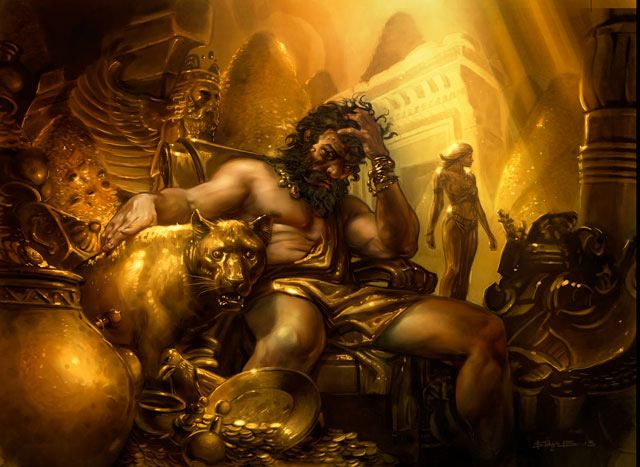
King Midas of Izbarda was the wealthiest king in all of the mythical sea of Geleda. And yet, no amount of wealth seemed enough for the god and his greed pushed him to overtax the people, force his armies to fight profitable wars, and to turn the markets in the favor of the crown. Greed had turned the kind-heart of a king into that of a tyrant.

One day, a satyr with golden horns, hooves and fleece was found in the garden of Midas. The satyr had become drunk and passed out from his festivities. The guards of the king went deal with the intruder but, upon recognizing the satyr as a servant of the trade goddess, the king commanded them to take care of the satyr. The satyr was given a place to sleep and given good food & drink upon waking the following morning. Aequitas came to collect her companion and, when she did, she asked Midas to name his reward.

Midas had seen the satyr turn the roses he had slept upon into gold and asked for that power. Aequitas warned him that the power should only be used lightly before giving him the golden touch.

The king ignored her warning.

King Midas turned his entire palace estate to gold: every brick and tile, every door and mirror, every piece of furniture and decor, every tree and bush, every bit of every into glorious and vibrant gold, all the while he grinned like a maniac with insatiable avarice in his heart. It seemed his greed was boundless as he turned everything to gold. He forgot and ignored the goddess's warning.

As the king sat before his dinner feast, all carried out golden dishes and accompanied by golden goblets and pitches of wine on a golden table cloth covering a table of gold, he rested and basked in the radiance of his work. His daughter, upset that her roses had lost their scent and became hard to the touch, came to he father to plead with him to obey the goddess's warning and use his gift more carefully. As he reached out to comfort her, he accidentally embraced her with the golden touch and, to his horror, she turned to gold.

He cursed the gods and begged for help from his servants. To his anguish, he no longer could control his golden touch. When the servants saw that their king had turned his own daughter into gold, they abandoned him. He was left in his palace, surrounded by his wealth, and soon he began to starve for, though the kitchens were plentifully stuffed, every piece of food he pressed to his lips became gold too. He had chose to disobey the goddess's warning.

And so the king would've died, wasting away in a tomb of gold surrounded by useless trinkets and treasures, and haunted by the visage of his own daughter. His heart was heavy and he wished to take his own life. And, as he suffered for his greed, he may have gone mad with anguish but his wails and curses and begging rants aimed at Aequitas were answered.

The goddess returned and asked the king what he wanted now. The king begged to have the goddess's gift taken back. She explained that taking away the golden touch was easy enough but it would not undo his handiwork. He begged that he would trade away his riches, his crown and even his life to just see his daughter returned to her living form. This seemed to please Aequitas.

She told the king to take everything from the palace, every piece of gold, every golden statue, every golden bench and brazier, and every golden brick and tile, down to the sea and toss them into it at once. The king obeyed. Midas threw all of his riches into the sea, every coin and every treasure, until the place his palace had stood was but dirt and rock. Lastly, he was told to take his daughter to the sea and to set her in the shallows. The king had grown weary but he dragged his daughter's golden form to the sea and collapsed just short of the tide. He feared he had not been strong enough, that his greed had done him in, and that he would die having failed his daughter. But the gods took pity upon him and fair Delphina washed a wave over him and his golden daughter.

His daughter pulled her father's head up into her bosom, crying and laughing, and the king realized that no treasure in the world was worth the simple pleasures of life.

Friday, December 16, 2016

Faiths of Sublanarya: Erys the Pink Lady


Erys is a goddess of mysterious origin: some say she is the descent of Nyx, the primordial goddess of the night, others say she is a wayward daughter/sibling of Grimnir Blue-Cloak or Puck Goodfellow or Pyrra, and others say she was born of the immaterial lies of mortals. Perhaps the goddess of discord prefers things this way. Confusion is her forte.

But, among the clergy of gods opposed to her wickedness, there is a theory that she is none of those things but instead she was a mortal witch who tapped into a higher power and rose the status of a goddess. The theory goes on that the witch preferred the freedom of her mortality and the challenges present in it. It is documented that there have been many Pink Ladies throughout the history of Narya, evil enchantress who use their magic to conquer and destroy, and it is believed that each one is a reincarnation of the goddess. It is believed that Erys seeks out a particularly attractive host who seeks her power, then takes over their mortal body, and reincarnates generation after generation into the descendants of that host until the host body is destroyed, she regaining her divinity, and starting the cycle once more. Perhaps she enjoys this more direct and mortal existence, where her powers are magnitudes greater than most mortals instead of being outshined by her immortal rivals who seek to keep her in check. After all, her pride, jealousy, and cruelty are legendary.

She takes pleasure in bringing ruin to all: from the young, fair and beautiful to wise, old and powerful kings, and especially to those that would deign challenge or insult her, even if they did so by accident or not at all. It was one such petty revenge that resulted in an entire country falling to ruin.

The legend goes that many of new gods were invited to the extravagant wedding feast of a powerful ancient king and his new blushing bride. Left out of the invitation was the Pink Lady, Erys. The invitations, most likely, were offered to the greater dieties as a token of respect but, when the gods obliged and sat in the garden of the mighty king, Erys took her lack of invitation as an insult and quickly grew jealous of the party that the gods and goddess were enjoying. She turned her eye to mischief and revenge, looking for a possibility for trouble, and found it.

The Four Sisters were taking turn admiring the handsome princes at the feast and, in particular, their attention fell upon a particular young man. Seeing her mark, she crashed the party and made her way towards the sisters.

So, the story goes, that Erys cast a spell upon the apple tree that the prince was sitting under so that a golden apple would fall, hitting his head, and roll to the floor. The Four Sisters rose to help the boy to his feet, he picked up the apple, and read aloud the rune inscribed on the skin: "For the Fairest of Them All".

The prince looked at The Four Sisters, who were too bewitched by the object, and the Four Goddesses asked the prince to give them each the prize. He could not give each of them the apple, so they pushed further and made it a contest. Each offering him a prize for his pick in turn: Delfina offered him safe passage on the seas and the sea's bounty, Soffia offered him wisdom and skill in war, Pyrra offered him passion and creativity in art, and Terra offered him patience and years of great harvest. The young man did not wish to insult the goddesses. In desperation, the boy thought he had solution that would not disrespect any of the goddesses.

He walked past them and handed the apple to the bride. After all, it was her wedding day and, at a wedding, the bride is "the fairest of them all". And, in truth, this may have pleased the goddesses and freed the young man from his impossible task if the apple had not been bewitched by Erys. Upon handing the apple to the bride, it had two immediate effects: they fell madly in love and the wedding party fell into a stupor.

By the time they were stirred from their relaxed state, the prince had stolen the bride away onto the fastest ship to his homeland. This bride's new husband demanded justice and the kin of the prince begged for mercy. It didn't take long for both sides to be in a civil war that would rage for years with the fate of the prince and the bride in the middle.

Erys may not have been invited to the party or been awarded the prize of the Golden Apple, but she had the last laugh.