Showing posts with label elves. Show all posts

Friday, September 29, 2017

Character Crunch: Snow Elves, Under-Elves, & Mud Elves

The iaurdin (high elves) and sylvanar (wood elves) are the most common elf subraces in Sublanarya. But they are not the only subraces of elves in Sublanarya. There are three other subraces known by the elves, distant cousins and long-lost kin, that are found in isolated places throughout the realm. They are so rare or rarely seen by the common folk that, to the masses, they wouldn't be recognized as separate or distinct races.

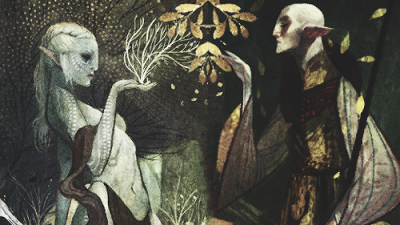
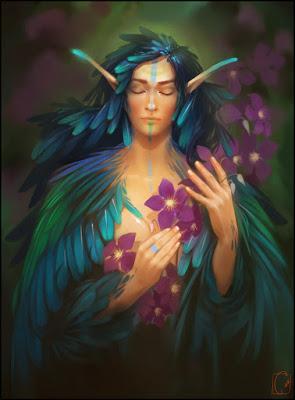
Far to the east, in the mountains of the Hold, the reclusive snow elves, also called "olossar" were once iaurdin. When the giants invaded the iaurdin kingdoms and enslaved millions, some iaurdin managed to escape slavery by hiding in the caves on the peaks of mountains that were difficult for all but smaller creatures to scale. Over centuries of hiding in the mountains, the olossar seperated themselves from the iaurdin and adapted to their new environment.

Olossar live in tribal units made-up of a few families and spend most of their time scouting their territory for threats, gathering materials, and keeping their cave homes warm. Inside their caves, snow-elves have cozy lives where they keep themselves occupied with crafts such as sculpting stone or making ornate jewelry or by practicing music that often fills their caves during the colder months. They mostly keep to themselves, even to this day, and are somewhat legendary among settlements near the Hold. They are often called"ghosts".

They do have a particular hatred for under-elves who hunt olossar to sell into slavery. While isolationists who generally avoid conflict, the olossar have been known to go to war against cliques of under-elves.

Olossar are shorter than most elves, standing at 5 to 5 1/2 feet tall, as an adaptation to help them withstand the cold. They have pale white to bluish skin with blue eyes eyes and white hair. These adaptations are to help camouflage them in the snow. Their hair tends to be thicker and less moisture absorbent than that of their cousins, allowing them stay warm and dry out faster, and the darker whites of their eyes help aid against being blinded by the snow.


Ability Score Increase. Your Constitution score increases by 1.
Winter's Child. You’re acclimated to high altitude, including elevations above 20,000 feet. You’re also naturally adapted to cold climates, as described in chapter 5 of the Dungeon Master’s Guide.
White Walker.  You can walk on water, snow and ice as if they were harmless solid ground without making a sound. You can cast the Water Walk spell on yourself as a level 3 spell. You regain this ability on a short rest. Constitution is your spellcasting ability for this spell.

Elf Weapon Training. You have proficiency with the long sword, short sword, long bow and short bow.

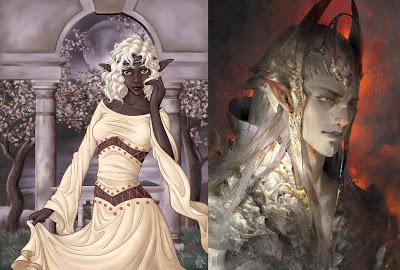
The under-elves of Sublanarya, also called the "grey elves", are another subrace that are descended from iaurdin. Not to be mistaken with the drow and other "dark elves", under-elves were created by giants experimenting to create better slaves for their mining operations. They proved to be more cunning than the giants could imagine and they escaped into the "world below".

This harsh environment has transformed the elves into that which they once hated. Slavers.

Under-elves, who call themselves the Haan or "the shadows", have adapted to the World Below by becoming harsh survivalists, cunning opportunists, and merciless adversaries. The haan are mostly known for raiding dwarven and gnome underground settlements, taking valuables and prisoners to either ransom later or sell into the World Below's nightmarish slave market, but attacks on other settlements are not unheard of.

Not many specifics are known of the Haan as those captured have either escaped or killed themselves before they would give up valuable information. It is known that each under-elves is part of a Haan group, called a clique, ruled by a matriarch. The matriarch is usually the eldest female in the clique. She gives the other members of the clique roles, most often showing preference for female haan, who are given roles as priestesses, healers and guardians of the clique's nursery where all the haan are raised as siblings by committee. The males are usually raised as warriors, hunters and scouts and have little say in clique affairs. The matriarch also acts as the clique's head priestess. As with so many elves who have abandoned Iaur, as they bear a deep bitterness towards their cousins, they have found comfort and guidance in the lies of Gwath-Yara.

The Haan have a grey skin tone with white hair and red eyes. They often dye their hair and tattoo themselves to signify their alliance to a clique.

Ability Score Increase. Your Charisma score increases by 1.
Superior Darkvision. Your darkvision has a radius of 120 feet.
Sunlight Sensitivity. You have disadvantage on attack rolls and on Wisdom (Perception) checks that rely on sight when you, the target of your attack, or whatever you are trying to perceive is in direct sunlight.
Under Magic. You can cast the invisibility spell on yourself as a level 2 spell. You regain this ability on a short rest. Charisma your spellcasting ability for these spells.
Elf Weapon Training. You have proficiency with the long sword, short sword, longbow and shortbow.
The madha or "mud elves" are the descendants of the fallen Ondo civilization. The Ondo were elves who built incredible stone structures in their colonies in the islands of Nuar but, after a great catastrophe destroyed their civilization, the survivors, most likely a slave caste, escaped to the jungles and devolved into a culture that is even more primitive than wood elves.

The madha stand between 5 and 6 feet tall with lean muscular builds, earth color skin, red and brown colored hair, and fierce yellow and green eyes.

They are a hunter-gatherer culture that worship natural gods like Sylvanis but also tend to fall easily for cult-worship. They are suspicious of outsiders and are extremely territorial as they tend to compete for survival against lizardfolk and other denizens of the jungle.

Ability Score Increase. Your Strength score increases by 1.
Hunter's Lore. You have proficiency with one of the following skills of your choice: Animal Handling, Nature, Stealth, and Survival.
Claws. Because of your claws, you have climbing speed of 2/3 your base walking speed rounded down (minimum 20 feet). Your claws are natural weapons, which you can use to make unarmed strikes. If you hit with them, you deal slashing damage equal to 1d4 + your Strength modifier, instead of the bludgeoning damage normal for an unarmed strike.

Monday, July 31, 2017

Of Lords and Ladies: The Elven Religion (IAURISM)


OF LORDS & LADIES:
IAURISM & THE ELVEN GODS


The story of the elves, as does many creation myths, with the Mother.

In the elven tongue, she is called Ontaria by the Iaur and Aemilia by the Sylvanar, respectively. Her name translates to "mother" or "begetter" and she is the ultimate creator god in the elven religion. And she is believed to have been the first star.

When she washed away the sins of the clay people and fled,  the Mother left behind her sons. Eldest among them was Iaur who created the elves by plucking stars from the sky. He saw the creation of the Twilight Realms and was so enraptured with the beauty of the Dawn that he decided to make it his home. In the Forest of Iaur, he built the Starry Vale for the young elven race and guided them from his palace, Silverhome.

In Silverhome, he lived alongside his consorts and his children, who would lead to his ruin and abandonment of the mortal world.

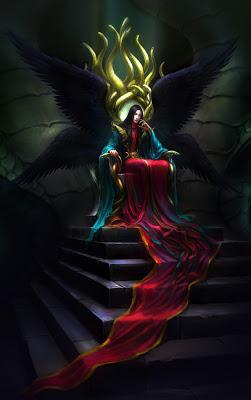
Traditionally, Iaur is depicted as a beautiful elf with long raven black hair, bright blue eyes and wearing either long robes of blue, red and gold. In modern depiction, he has taken on a more militant appearance with silver plate armor, a long sword and shield with a blue banner. He is also often depicted with four black wings.

Personality-wise, Iaur is known to be a champion and advocate for the beautiful, the true and the good. His unequaled mastery of the arts, as an extension of his appreciation, has been passed down as gifts to his mortal children: the mastery of music, sculpture & paint, the expertise in glass/metal works & architecture, and their inherent talent and mastery with the arcane arts has allowed the elves to build wonders that are the envy of the world. He blessed his children with adaptability: wherever elves find themselves, they find a way to thrive.

Lord Iaur's appreciation for beauty is admirable but has consequences. He had many beautiful companions and concubines. Their beauty blinded his judgement and allowed them the opportunity to undermine his rule. Their envy drove them to dark and dangerous extremes.

His first wife, Lady Rin-Varna, is a goddess of love, life, and starlight. She is the loremaster and creator of the written language of the elves. It is she that taught the early elves the art of elven rune magic that allowed them to live undisturbed the strange creatures of the Twilight. She is the mother of Kuron and Hurin.

Kuron is a female warrior goddess associated with the hunt and the wild. She is often depicted as teaching martial skills to the elves, such as the mastery of the blade and bow. She had friction with her father for eschewing the finery of his court but was a loyal daughter. Her brother, Hurin, on the other hand, while embracing the finery and manners of court, took great pleasure in embarrassing his father by participating in debauchery from overindulging in fine food, drink and flesh to throwing never-ending and frivolous parties. His libertine attitude earned him reprimands from his father that rebuked by undermining his father by participating in the fey court. While he helped the fey court conspire against his father, he is no one's true ally, and instead takes pleasure in the artistry of deception and betrayal. These "jokes and japes" that he played distracted the court and allowed the machinations of the greatest foe of elfkind to go unnoticed until it was almost too late.
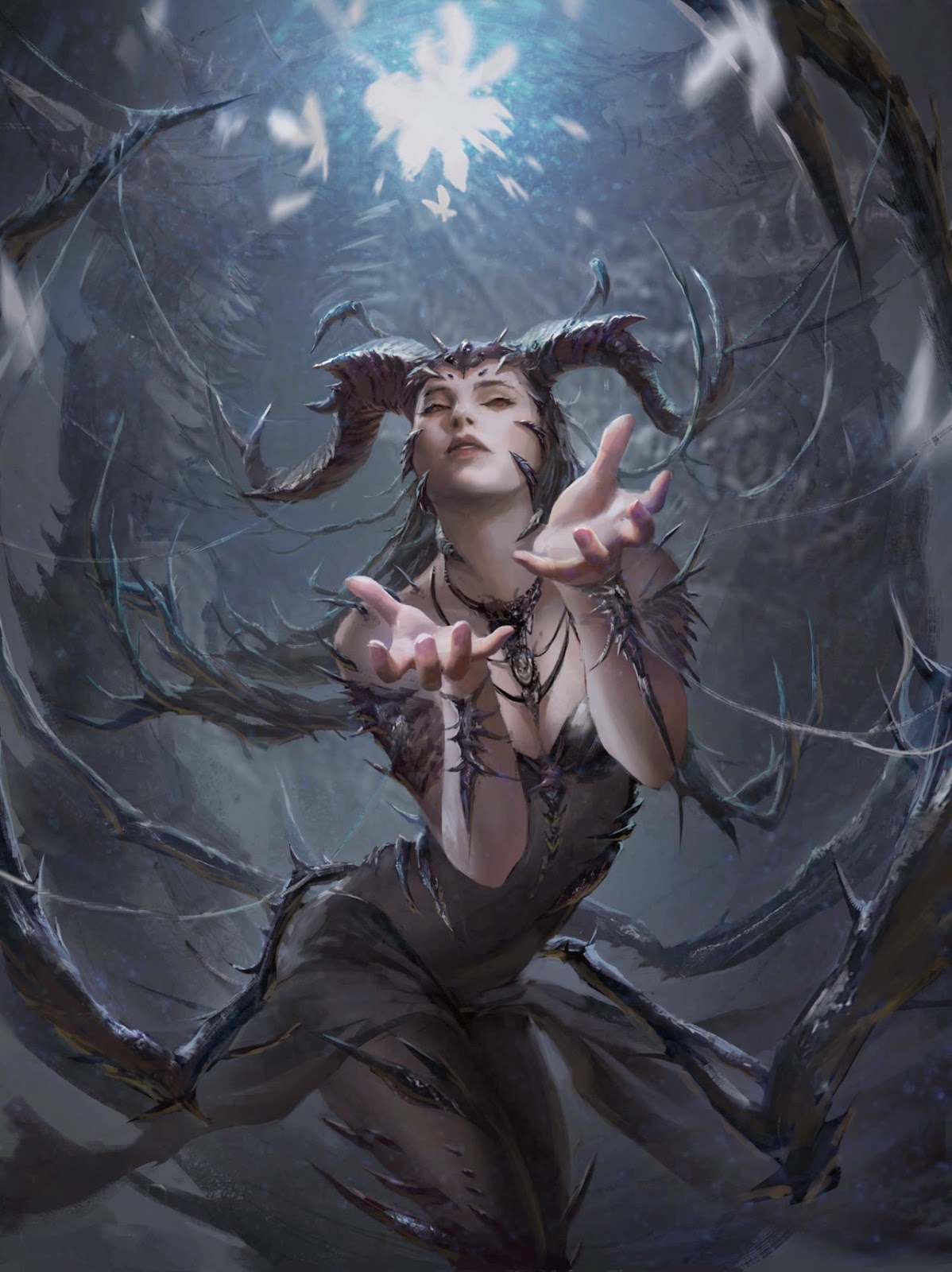
From the darkness between the stars, as if a dark mirror of Rin-Varna, Gwath-Yara found her way to the court of Silverhome. Born of the old one Attlakanakha the Dream-Weaver, Gwath-Yara seduced Iaur into allowing her to join his harem of wives, husbands and consorts and quickly began infecting the Silver Court with her influence. She bore Iaur a son and a daughter. This was all in her plan to have Rin-Varna killed so she could become the queen of elfkind and, eventually, turn on Iaur as well. Once her son and daugter were grown and she felt more secure in her place, once she had Iaur wrapped around her finger and Rin-Varna believing her to be as a sister, and once she had a plan that she believed could bring them all down she set her eyes upon getting Hurin and Kuron out of the way. She took advantage of their friction with court and set them up: Kuron abandoned the court and Hurin was exiled.

And then the Alliance of Gloom descended upon the Silver Court.


An army of dark fey, allied with the twin sisters, were led to the Starry Vale and lay siege to Silverhome. Gwath-Yara used information she had plied from Hurin so that they could break into the forest of Iaur and when Kuron left in a huff, her warriors went with her. This left Iaur to fight the dark forces while Rin-Varna guarded his people in the walls of Silverhome.

The dark fey had underestimated the might and magic of Iaur, especially in his own home, and his wrath towards their ugliness and evil manifested in a terrible manner:

He turned the dream-like glamor of his realm into phantom nightmares that tore at their minds and bodies and each swing of his blade penetrated the dark horde like the rays of the sun. Still, his fey enemies were joined by more powerful foes: the patron gods of giants, orcs, and goblins, as well as several demon lords, joined in their invasion. He struck down many of them but their numbers and strength overwhelmed him and he found himself transforming into a great feathered serpent as he wrestled with them in the vale in a deathgrip. Without aid, they would overcome even his power and he would die…
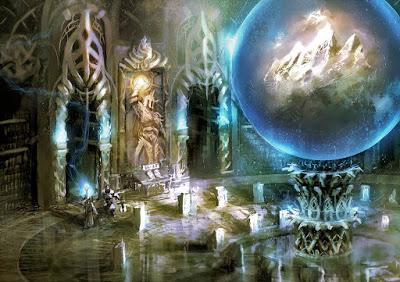
Meanwhile, the wicked consorts, Gwath-Yara, hid inside Silverhome with Rin-Varna until they could spring her own trap. She had poisoned Rin-Varna and positioned herself as her protector and care-taker as she fell ill. With the court distracted by the invasion, she prepared to end Rin-Varna and blame it on the invaders. But, with the timing that only Hurin is capable of, he intervened and saved his mother. He had suspected some treachery was afoot and, when he saw the Alliance of Gloom descending upon the forest, he went to find Kuron. He apologized and begged her to come quickly.

Her hunters easily turned the tide of battle and helped free Iaur. They sent Iaur's enemies, maimed and humiliated, fleeing but promising vengeance. They then turned to Gwath-Yara and her co-conspirator Kytix. The girl was another consort of Iaur and Gwath-Yara had turned her against him. She had helped her the whole time out of her spite towards the other members of Iaur’s harem.

Rin-Varna lay dying.

Before Iaur could deal out his punishment on the evil beings, he plead with them for a cure for Rin-Varna’s illness. Hurin’s heart grew heavy with guilt and disgust and fury as they laughed at his father. For the first time, he felt remorse. He had not been there to protect his mother. He had allowed his pride to blind him from such obvious treachery. He had also failed to protect his father. And so, he came up with a plan:

As the two stewed in the cell, Hurin came to them with an offer: the first share the cure would be forgiven of their crimes.

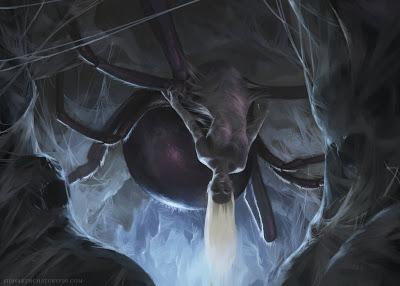
Kytix immediately turned on her mistress and gave Hurin the cure. Gwath-Yara turned into a giant monstrous spider, showing her true form, and attacked Kytix. Kytix, having the body shifting powers of the elven gods, changed shape into a ghostly white spider to defend herself. The struggle was so intense that they broke free from the cell and the battle continued into the palace above. Hurin rushed to find his mother a cure as Iaur tried to contain the two creatures. He refused to kill them. A small part of him loved them but, even moreso, he did not believe they deserved a quick death.

Rin-Varna quickly recovered and came to Iaur’s aid. She first cast Kytix down into a world beneath the mountain. Never again would she gaze upon the stars and there, in the dark, she would remain transformed into a monstrous spider woman. Gwath-Yara required a more powerful banishment. She tried to flee back beyond the stars but Rin-Varna and Iaur shaped the stars themselves into a net, catching the spider and trapping her there in the darkness between the stars. No longer would she dwell beneath or beyond the starlight. She could only send her whispers along strings of shadow.

They fates of the Gwath-Yara’s son and daughter are also an important story in elf lore.

Her son, Assarr, was the perfect member of the court. Handsome, clever and chivalrous. He had the allure of his father and his mother’s cunning. He gained a reputation as Assarr the Irresistible. After all, if you could not get into the bed of the king, the prince was the next best thing. He was undeniable and he was never denied his desires.

Her daughter, Nyeera was Iaur’s favorite child. Her beauty was only matched by her talent, kindness and gentle-heart. Even Rin-Varna could not resist her and took the child as her favorite attendant. Together she helped Rin-Varna weave music into the elven tongue and she constantly impressed her father with artistic innovation. But the same charms that won over the rest of the Silver Court also put her in the cross-hairs of her own brother.

Assarr, unlike Nyeera, was susceptible to their mother’s dark corruption. She had molded him into the picture of courtly perfection with the intent of making him king some day. She encouraged his appetites. His morals were twisted and, even with his mother gone, he could still hear her whispers. She turned his desires into a madness and his wishes became increasingly impure. The only one more desirable than he was the child that none would dare approach with romantic intent. Nyeera was too pure and kind. And the sick son of Gwath-Yara developed a fantasy: to overthrow his father and rule with Nyeera as his bride!

Hurin saw the way his half-brother looked at his half-sister and tried to warn Rin-Varna. His concerns were rebuffed. After all, Assarr’s reputation was as clean as crystal. Kuron believed he was making trouble. Hurin knew better and began to keep an eye on Nyeera.

One night, while Nyeera walked in the ever-blossoming garden of Silverhome, the moon cast an ominous red light over the scene below. Assarr approached Nyeera from the shadows and made his dark confession. Nyeera rebuked him, as mercifully as she could, and begged him to reconsider. She begged him forgive her for it and she begged him to turn his heart’s desire elsewhere. Assarr had never been denied anything by anyone. In that moment, something broke and the prince showed his trueself. A monster. He attacked Nyeera. Luckily, someone was watching.

Hurin intervened, having been watching from nearby, and came to Nyeera’s defense. The two half brothers became locked in combat and, quickly, Hurin realized he was no match. Hurin called for Kuron and, like a swift wind, she came. The huntress threw him out of the garden and the prince’s ferocity immediately turned to cowardice. He ran to his father. He threw himself upon the floor and begged for his father’s protection. He spun a story:

According to Assarr, it was Hurin who was the predator in the court. He had intended to assault Nyeera and, in the process, ruin Assar’s reputation. Hurin disguised himself as Assarr since, after all, he was a master of disguise. When he heard his sister scream, he came to her aid, only to be attacked by Hurin and Kuron.

As Assarr finished spinning his elaborate lie, his other siblings arrived. Iaur demanded an explanation and relay the accusations of Assarr. Hurin pointed out the falsehoods in his story and that the blood upon the white-haired lord's lips was not his own. In his lustful attack, he had bitten Nyeera's neck. Rin-Varna banished Assarr to the deep, dark depths of the material plane, in the World Below, and Iaur cursed him:

He became the monster within. From that day onward, Assarr recoiled from the sun and was filled with unending lust for blood. Assarr was the first vampire. Perhaps, Iaur and Rin-Varna would’ve kinder and wiser to destroy him. After all, this scandal proved the final straw for many of the first elves. The elves that had been loyal to Gwath-Yara and Assarr felt betrayed by Iaur. They abandoned Silverhome and fled to Assarr’s side. Those most loyal became the first vampire lords, the Assarrites, and the first “drow”. These “drow” or “dark elves” were pale with fangs, red eyes and bat-like features. The drow were a slave race for the vampire lords and built an empire beneath the world surface, terrorizing the citizens of the underworld, and Assarr reigned as a living god.

Eventually, during the Wyrd Wars, this empire was weakened by multiple conflicts. In the final battle between Mal-Dorig and the gods, Assarr took the dread conqueror’s side and was dealt a devastating defeat by his father. Many of the surviving by vampire lords fled to the far corners of the world to infect the above world with their curse but others took Assarr deep below the world to recover. Other drow finally escaped enslavement and found a way to break their vampiric curse but still had adapted to live beneath the world and returned there.

The drow have a reputation for being evil-doers; most interaction those in the world above have with drow is with drow raiders but not all drows are slavers. Those slavers are most often Gwathnir, those who turned to Gwath-Yara for guidance, and are villains among most other peoples of the dark underworld. But others worship other gods and have other careers. Some are pirates, some are merchants, some are cultists, some are priests, but they are all artists. And they come in all manner of unusual hues. The Assarite drow may have been so pale as to be almost translucent but the freed drow are spectrum of reds, blues, purples, and darker hues.

As much as it is a shame that the elf-father has lost a connection with his children, it is even more a shame the world cannot appreciate the beauty these elves have cultivated out of their pain.

As a last note, it is important to remember most known version of the elven religion are written by the Iaurdin, who left Saesun at the dawn of the second epoch and their religion, as well as their gods, reflects their values. The Sylanar, the elves who stayed behind on Saesun, often envision the gods in a more naturalistic way as embodiment of natural forces and include the druidic gods, like Silvanus, in their versions of elven myths.

Like the Iaurdin, the Sylvanar value beauty, but in more natural and liberated form compared to the heavily constructed and controlled beauty of Iaurdin society.

Iaur had many more consorts and children. Their tales remain to be seen as we discover more of elvenkind.

Saturday, October 1, 2016

Empire Ascendant: Imperial Holdings of The Tytanyan Pact


THE TYTANYAN PACT: 
SAESUN, SMOLDER, ALBYON, & NUAR

A century and a half ago, the Isle of Saesun was gripped in a civil war between human kings. Their ancestors had come to the peaceful paradise isle as refugees. Out of mercy, the iaurdin convinced the sylvanar and the metallic dragons to let the humans settle until they could return back to the east. The humans settled and were allowed to use the lands as they wished as long as they respected the sacred groves of the sylvanar. The elves and dragons managed to keep the peace between the settlements as they developed into kingdoms. But perhaps it is in the nature of humans to quarrel. The humans began fighting over valuable resources, bickering over petty misunderstandings and creating war out of nothing. The metallic dragons picked sides and, after thousands of years of peace on Saesun, war broke out.

The elves tried to broker peace, they tried to abstain, but the men of Saesun began burning down their forests, killing their sacred animals, and escalating the war to greater heights. The sylvanar tried to intervene out of self-defense but brought the war home. The death of the sylvanar king, Opheros, was the final injustice that the iaurdin could not bear. Something had to change.

Since the beginning of the world, Saesun and the elves had been protected by powerful celestial runes that not only prevented invasion but helped keep many dangerous extra-dimensional threats from entering the world of Narya by force. Among these forces, were the chromatic dragons trapped since the Creation War. Queen Tytanya used her knowledge of the arcane to change the runes so that Red Typhon and his tyrant lords could enter Sublanarya through a gate she opened in Ryn-Durazar.

The following war was swift: the dwarves of Ryn-Durazar first endured devastating natural disasters caused by the gate opening and then were forced to abandon their homes under threat of dragon fire, then the iaurdin and the chromatic dragons forced the human kingdoms into submission, and the metallic were exterminated.

Ryn-Durazar became Smolder, the home of the chromatic dragons, and Saesun became the heart of the iaurdin empire. Together, they formed the Tytanyan Pact and the Tytanyan Age began. Over the next hundred years, they took complete control of the western seas of Sublanarya, colonized the island chain off the coast of Tazlan, and conquered the western kingdoms of Thule. The islands became Nuar and the kingdoms became Albyon.

Together these regions form an empire that have shaped the events of the last century in Sublanarya. But this realm is not merely an army of elves and dragons; it is a place of incredible natural beauty and home to the millions of citizens of the empire.

Saturday, September 10, 2016

"The Little Peoples": Dwarves, Gnomes, and Halflings

THE LITTLE PEOPLES OF SUBLANARYA

Sublanarya is not merely populated by elves, humans and their ilk; in fact, there are over a dozen sentient races that make home to the realm and today we're discussing the next three races that strongly characterize the north western region of Sublanara and they have one thing in common: they are all short.

Yes, really, that is the rather lazy bond these three races share or it would be if they didn't have something else in common: they are three races that have depended on and supported the elves and are all caught between the machinations of those two more dominant races. The relationship between humans, elves and the "little peoples" is actually quite fraught at times but ultimately they are passengers on the crazy ride of the Tytanyan Age and the stagecoach drivers are fighting.

Despite being pushed aside by the egos of human and elf empires, these races have each found their specific niche and will likely continue to play their part in the upcoming theater of economics, politics, war, religion, and magic.

Wednesday, August 31, 2016

Iaurdin: Gods Save The Queen (The High Elves)

A long, long time ago, the elves were said to be one people.

They were the Iaur. They were descendants of the family of elf gods and gifted with a most beautiful, magical and protected home. The Isle of Saesun. They were guarded over by wise and powerful metallic dragons. They lived in a paradise free from strife or woes. They were innocent. They were children. Then, some of these children left home.

The children discovered evil. A few generations enslaved by the Naryan giants cut these elves off from nature, from whimsy and from innocence. In the hellish crucible of slavery, a blade was forged in the mines by an elven blacksmith. The blade was taken in the hands of the blacksmith's daughter. She used it in her escape from the Golden City, she wielded it in her duel with the Bjergfolk chieftain, and she raised it above her head when she led Bjergfolk back to the Golden City to free her people.

It is said that the blade has no magical qualities and is not beautiful to behold. It is a rather dull and uninspiring weapon. And yet, in the hands of the elven maiden, the blade forged by one in chains, the blade that broke the chains, the blade that freed a nation, the blade became legendary. Today, the blade hangs in the throne room of the Palace of Grand Saeffura on the wall behind the throne itself. The blade is called Chainbreaker.

The blacksmith's daughter became Queen Tytanya.


Queen Tytanya may be the most powerful mortal being in all of Sublanarya, if not Narya. After returning to Saesun, she was made queen of the iaurdin. The iaurdin are called "high elves" by themselves , "great elves" by their allies and "pointy ear bastards" by their enemies. And they have many enemies.

By allying themselves with the chromatic dragons to form the Tytanyan Pact, the iaurdin have become the most powerful empire in Sublanarya. From the Isle of Saesun in the Northwest to the conquered Thule territories, Albyon, to tropical colonies of Nuar in the South, the high elves ambitious expansion is impressive for such a contentious region. Viewed as invaders by their enemies, rebels sprouting up all along their outer territories, and held in contempt for their practices, the high elves are not well liked by other Sublanaryan factions. Their actions have caused great instability in the geopolitical landscape. And yet, the irony is that, within the borders of this empire, life is more stable than anywhere else in Sublanarya.

While the rest of the land sees them as conquerors, the iaurdin see themselves as saviors.

Monday, August 8, 2016

Dragonkind: The Pyramid of Power

DRAGONKIND: THE PYRAMID OF POWER

Chromatic dragons are lazy, greedy and arrogant: that comes with being incredibly powerful, both physically and magically, and thus being able to coerce lesser creatures to serve you, it comes with filling a lair with an increasingly impressive treasure hoard proportional to how much much one can coerce the creatures around them and it comes with thinking of oneself as the apex of creation.

It comes with being a dragon.

But these qualities has several drawbacks too: they don't like to work hard, preferring to rely on their power and cunning to make other creatures do their bidding, only throwing their power around for pleasure and profit rather than as strategically as they should. Their greed overrides their better judgement, making them vulnerable to manipulation, and blinds them to obvious danger. And, most importantly, dragons don't like other dragons. Other dragons are competition for territory, for property, for breeding, and so on, and every other dragon is a challenge to a dragon's superiority complex. The only thing a dragon hates more than weak dragons are dragons that are more powerful than themselves.

So how do you get dragons to work together?

Red Typhon.

Red Typhon is a red dragon but not just any red dragon: he's older than the earliest civilization of Narya, so massive that his shadow sends entire nations into a panic, so clever that he has gotten chromatic dragons of every color to conform to his wishes, and so powerful that only Queen Tytanya herself gives him pause.

Red Typhon was one of the attendants of Tiamat, the evil draconic goddess supreme, and served her for eons as her most beloved "groom". But, after Abzulon's sacrifice & Tiamat's defeat trapped him for millennia, he became desperate to escape Armageddon. That was when he heard the siren call of Tytanya and she made him an offer he couldn't refuse. With his dragons, she was able to defeat her enemies and he was rewarded with a kingdom of his own.

But what do dragons do with their own kingdom? How do you keep them content? How do you keep them under your claw?

Wednesday, July 27, 2016

Dragons: The Creation of Narya & The Masters of Smolder

“My armor is like tenfold shields, my teeth are swords, my claws spears, 
 the shock of my tail a thunderbolt, my wings a hurricane, and my breath death!”


Perhaps, no monster in fantasy is as iconic as the dragon. After all, they don't call it "Dungeons and Hydras" or "Dungeons and Owlbears". Nope. They call it Dungeons and Dragons.

 DRAGONS

I am sure you know the answer to this question but, for the sake of this article, humor me: what are dragons?

Dragons are legendary creatures with serpentine, reptilian and avian features and, typically, fly, breath fire and possess magical qualities. There are two main types of dragons depicted in literature and media: European, which are animalistic reptilian sexrupeds (possessing four legs and two wings) and Eastern, which are  intelligent serpentine quadrapeds. Traditionally, Dungeons and Dragons is more concerned with intelligent European-style dragons, but these two paradigms hardly represent the gamut of draconic creatures depicted in cultures from around the world. Why are they so omnipresent in world cultures? By answering that question, we can probably understand why they might just be the ultimate monsters.

Dragons, of some sort, seem to be represented in civilizations across world history independently of each other. These legendary creatures are even found in the art and religions of civilizations like ancient Mesopotamia, such as with the depiction of Tiamat (depicted above), the inspiration for the classic Dungeons & Dragons villainous god. Personally, I adhere to the theory that I'll call "omnimythical" or, that is to say, that dragons are an example of a mythological staple in all cultures due to universal needs and shared ancestry. In this case, dragons serve as both an amalgam and exaggeration of primal fear for creatures including but not limited to: snakes, large lizards, crocodiles, large cats, birds of prey and more. By combining the features of these creatures, the quadrupedal body of a large cat,  the wings and talons of a bird of prey, the scales of large reptile, and the elongated neck similar to that of a serpent, we come upon a shape representing the animals that threatened men in the wilderness. It honestly makes more sense than dragons have ever existed outside of these myths.

And, as for the fiery breath, I'm not exactly sure about the origins of that myth but it is easy to imagine the dangerous power of fire if you've ever seen a large wildfire, a building catch fire or the use of a flamethrower. The addition of that, mostly, supernatural element creates an enemy that is more dangerous than any natural predator and, by combining that with human or above human intelligence, we get the iconic villain of fantasy.

Side note: I would love to hear some theories on why fire breath is practically omnipresent in dragon mythology?

As is traditional in Dungeons and Dragons, there are good dragons and evil dragons in Sublanarya of various metallic kind or color. Most dragons in Sublanarya are evil "chromatic" dragons and, in fact, in the Tytanyan Age, there are believed to be no good "metallic" dragons left alive. The smallest dragons are the size of a horse and the largest can take on truly unfathomable proportions. Quadrapedal, winged and reptillian creatures with high intelligence, an affinity for magic, breath weapons, and, in the case of chromatic dragons, a strong desire for power, wealth and comforts.

There are other true dragons but those are not relevant in Sublanarya.

Ultimately, in the world of Narya(yes, I'm done with the silly book report section of the article), dragons play a vital role in not only the balance of power but in the creation of the world itself. This article will breakdown the creation myth of Narya, the role of dragons through out Sublanaryan history, and the dragons of Smolder in the Tytanyan Pact.

Tuesday, July 19, 2016

"So, what if the elves are the bad guys?"

This is probably a strange place to start but BARE WITH ME because I do get into some lore that, honestly, I find engaging:

I'm sure this isn't a completely and wholly original idea but that is where it started. The seeds for this dream started with binge watching Netflix. I had been watching a lot of Star Trek: Deep Space Nine. 

 A major contribution of DS9 to the Star Trek Universe, in my opinion, was the exploration of the effects of colonization/resistance/revolution, etc.,  and the addition of species with more complex and deep cultures. Traditionally in Star Trek, each species could be soully defined by a single characteristics: Vulcans are logical and Klingons are warriors. DS9 introduced species with far more complex motives and persona that were harder to pin down while being more relatable and alien to humanity: the Cardassians and the collective species that make up the Dominion.

The Cardassians were very believable as an alien species because they were a dark mirror of humanity in the Trek verse. They shared a lot of personality traits but, collectively, chose a path of militarization and conquest. When confronted with the objectively morally superior Federation, the Cardassians are often forced to defend themselves as individuals and their entire culture. It is fascinating to see the mental gymnastics a Cardassian character has to go through to justify genocide and colonization. After all, they are basically Star Trek's equivalent to nazis.

The Dominion, on the other hand, catches my interest because of the interaction between a variety of species to create a complex hierarchy. They are lawful society, despite creating entire races for slavery and committing genocide against their enemies. Why? Because it is all justified under the auspices of creating a safer galaxy (mostly for themselves) and that is a fascinating motive for a species painted as antagonist. They are tyrants but, ultimately, they're selfishly benevolent tyrants and that is what I wanted to build upon.

So, I decided that in my setting, I wanted to re-purpose classic fantasy races to tell the stories this world is designed to tell, while remaining true to many of the core elements and themes of the species, but also evolving species into very interesting roles previously unexplored. After all, my fantasy settings tend to lean away from the medieval and more towards the Renaissance. I want to create a world that mirrors the "Age of Discovery".


With that in mind, we get to the question at the impetus of this setting's creation:

So, what if elves ARE the bad guys?